By Dr. Aisha Thornton
Urban planning for climate resilience is no longer a theoretical ambition but a vital and bold imperative for cities worldwide. As climate-driven shocks—floods, heatwaves, and storms—become more frequent, planning must rise to meet them with strategies that are both innovative and just. This essay explores how cities can harness nature-based design, inclusive governance, integrated infrastructure, and equitable policy to build urban planning for climate resilience that protects vulnerable populations, enhances ecosystems, and strengthens communities for a sustainable future.
Framing the urgency of urban planning for climate resilience
The 21st century has seen escalating climate disasters that disproportionately affect urban areas. Cities concentrate people, infrastructure, and economic assets, making them epicenters of risk. The Intergovernmental Panel on Climate Change warns in its AR6 Working Group II report that without adaptation, urban populations face mounting health crises, economic losses, and ecological collapse. Flood-prone megacities like Dhaka and Jakarta show how unchecked urban expansion collides with rising seas, while New York’s experience during Hurricane Sandy revealed the vulnerability of even advanced economies. Scholars writing in a systematic review published by the National Library of Medicine stress that resilient planning must pair physical infrastructure with institutional and social systems to reduce vulnerability and improve adaptive capacity.
Lessons from history: when planning failed communities
History demonstrates that ignoring resilience has devastating costs. In New Orleans, Hurricane Katrina exposed racial and economic inequities embedded in land-use decisions and inadequate levee maintenance. In Karachi, rapid informal development without drainage infrastructure has left millions exposed to annual flooding. Cape Town’s “Day Zero” water crisis in 2018 nearly cut piped water for millions. As reported by The Guardian, citizens reduced consumption to just 50 litres per day and adopted community-level rationing, which ultimately helped avert the worst outcomes. These failures highlight that resilience cannot be engineered solely through technical fixes; it requires embedding justice and foresight into the very fabric of planning.
Nature-based solutions: sponge cities and green infrastructure
One of the most innovative approaches to climate resilience is China’s “sponge city” model. These designs incorporate permeable pavements, green spaces, constructed wetlands, and bioswales to absorb stormwater, reduce runoff, and enrich biodiversity. The Financial Times has profiled how pilot projects in Wuhan and Shanghai have mitigated flooding while also improving urban livability. Cities elsewhere are adopting similar measures: Vienna uses subterranean retention systems, and Philadelphia has deployed rain gardens and porous asphalt, transforming stormwater into a civic asset.
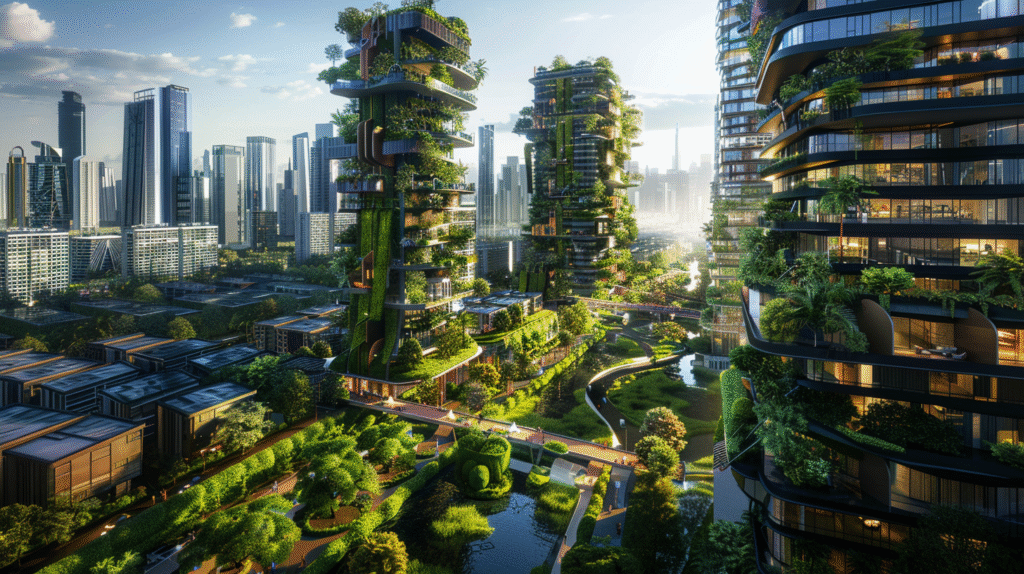
Green infrastructure complements sponge city design. The U.S. Environmental Protection Agency highlights how green roofs can reduce surface temperatures by as much as 40 °F, lowering energy consumption and mitigating heat islands. Singapore’s “City in a Garden” approach demonstrates how greenery can be integrated into high-rises, transit hubs, and flood control systems, turning ecological function into everyday design.
Integrating data and governance for equitable resilience
Resilient planning today depends on both data-driven tools and inclusive governance. Geospatial mapping, satellite imagery, and predictive models allow planners to identify risks and test interventions. For example, LAist reported on UCLA’s new heat-mapping initiative, which helps Los Angeles allocate resources to neighborhoods most at risk of extreme heat.
Yet technology without justice can perpetuate inequity. The UN-Habitat Urban Resilience Hub shows how Chicago has integrated climate risk into zoning, housing, and transportation policy, prioritizing vulnerable populations. In Lagos, participatory mapping empowers informal-settlement residents to advocate for drainage and flood protections, ensuring that community knowledge shapes adaptation.
Housing, zoning, and equity in adaptation
Resilience is inseparable from housing justice. Eco-district redevelopment often leads to “green gentrification,” displacing long-time residents in the name of sustainability. New York’s Resilient Edgemere Community Plan is a different model. As the Georgetown Climate Center explains, the plan offered land swaps and relocation assistance to residents in high-risk zones, while converting vacated lots into open spaces that doubled as flood buffers. In addition, CityLimits reported that the City Council approved zoning changes creating a Special Coastal Risk District and more than 500 units of permanently affordable housing, showing how resilience and equity can reinforce each other.
Housing policy also intersects with climate adaptation through the need for cooling infrastructure. Our own essay on Shade Is Infrastructure: Designing Cities to Survive Heat demonstrates how equitable access to shade, trees, and cooling spaces becomes a matter of survival in hotter cities. Integrating such measures into zoning codes ensures that resilience includes both flood protection and relief from extreme heat.
Transportation resilience: moving people safely through climate shocks
Transit systems are lifelines for cities. When floods or heatwaves disable mobility, economies falter and essential services stall. Tokyo protects its rail networks with underground flood tunnels, and London’s Crossrail incorporated flood-resistant stations. Shenzhen’s electric bus fleet not only cuts emissions but also proves resilient during air-quality emergencies. Miami is piloting elevated bus lanes and amphibious shuttles to keep routes open even during storm surges. Micro-mobility—bikes, scooters, pedestrian corridors—requires climate-proofed infrastructure like shaded lanes and resilient pavements to remain reliable under extreme conditions.
Public health as a pillar of resilience
Climate impacts manifest directly as health crises, from heatstroke to vector-borne disease. Hospitals and clinics must be climate-proof, with backup power and cooling capacity. During Europe’s 2003 heatwave, thousands died where such systems were absent. To prevent repetition, Los Angeles has expanded access to community cooling centers. As LAist notes, libraries and community spaces now stay open longer during heat emergencies to protect vulnerable residents. The World Health Organization has called for “climate-resilient health systems” that integrate infrastructure, staff training, and emergency preparedness into health policy.
Tools and standards for resilience assessments
Resilience is increasingly entering the realm of finance and law. ASTM International’s new property assessment standard, E3429-24, integrates climate hazards into real estate due diligence, helping developers and insurers price long-term risks. Meanwhile, climate bonds and green financing mechanisms are channeling capital into flood defenses, renewable grids, and resilient housing. These tools make resilience not just a planning ideal but a financial reality.
Global south perspectives: adaptation under constraint
Cities in the global south face acute risks but also lead in innovation. Dhaka’s floating schools and amphibious homes adapt architecture to waterlogged environments. Medellín’s “green corridors,” credited by UN-Habitat, reduced local temperatures by nearly two degrees Celsius, showing how political will can deliver tangible climate relief. These experiences remind us that resilience cannot be dictated from wealthy capitals; it must be forged in diverse contexts with shared learning across borders.
Regenerative design: beyond sustainability
Urban planning is evolving beyond sustainability toward regeneration—actively restoring ecosystems while empowering communities. Singapore’s Bishan-Ang Mo Kio Park, once a concrete canal, was transformed into a meandering river and floodplain that filters water and provides public space. Bangkok’s Chulalongkorn University Centenary Park, designed by Kotchakorn Voraakhom, is another model. As highlighted by UN-Habitat, its wetlands and retention ponds absorb monsoon floods while doubling as vital urban green space.
Building resilience through interconnected systems
Resilience cannot be siloed into projects. The Social-Ecological-Technological Systems framework emphasizes how infrastructure, ecosystems, and governance must work together. The UN-Habitat City Resilience Profiling Programme illustrates how cities can align meteorological agencies, health systems, and local communities in early-warning networks, ensuring that protective measures actually reach those in need. Integration is what transforms scattered initiatives into durable resilience.
Looking ahead: toward a resilient, just urban future
Urban planning for climate resilience must evolve from reactive measures into systemic transformation. The future lies in cities that expand sponge-city designs, mainstream green infrastructure, safeguard affordable housing, strengthen health systems, and embed equity into governance. The challenge is not just to protect wealthy districts but to secure the dignity of frontline communities.
The stakes are generational. Resilient cities are not only prepared to withstand shocks—they are regenerative, inclusive, and just. By weaving together nature-based solutions, data-driven governance, and equity, tomorrow’s cities can thrive amid uncertainty. Urban resilience is about more than survival; it is about flourishing together.