By Dr. Aisha Thornton
This summer, Phoenix recorded 31 consecutive days above 110°F. In Delhi, rooftop temperatures climbed so high that tin-sheet housing warped. Paris, once known for temperate summers, is rewriting building codes to address lethal heat waves. Around the world, cities are learning a hard truth: extreme heat is not just uncomfortable, it is deadly.
Yet most urban policy still treats shade as an amenity rather than infrastructure. Trees are considered beautification, awnings a design flourish, green canopies an afterthought in the fight for limited budgets. The result is predictable: wealthier neighborhoods enjoy leafy streets and shaded parks, while low-income residents endure what researchers call the “heat gap”—a measurable difference in ambient temperature that maps almost perfectly onto race and income.
Heat as the Silent Killer
According to the World Health Organization, extreme heat kills more people annually than hurricanes, floods, or wildfires. In the United States, it claims more than 1,200 lives each year—figures likely underestimated given how often heat deaths are coded as cardiac or respiratory failure. The danger is cumulative: longer heatwaves mean less nighttime cooling, straining the elderly, outdoor workers, and those without access to air conditioning.
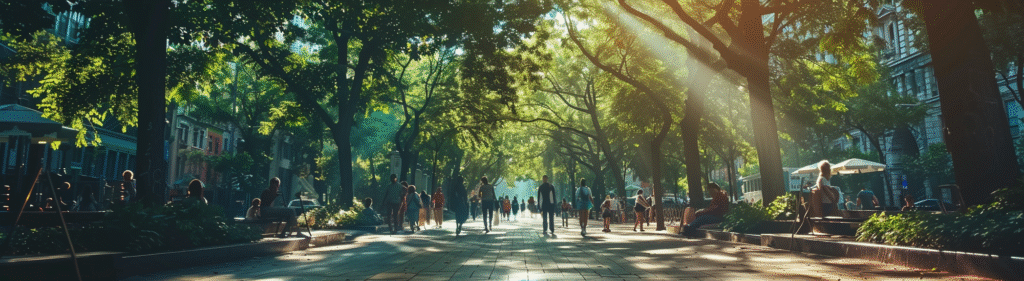
Shade, in this context, is no luxury. It is a frontline defense. A shaded street can be 10 to 15 degrees cooler than bare asphalt. Access to tree cover reduces emergency room visits during heat events. Yet urban forestry budgets are routinely slashed, and shade planning rarely appears in capital infrastructure proposals alongside roads, sewers, and bridges.
Designing for Equity
The inequities are stark. A 2019 study found that majority-Black neighborhoods in U.S. cities are, on average, five degrees hotter than whiter, wealthier ones. Similar patterns exist in Latin America and South Asia, where informal settlements often lack both tree cover and reliable utilities. These are not accidents of climate; they are consequences of planning decisions.
Equitable heat adaptation requires reframing shade as essential infrastructure. That means targeting tree-planting not just where it is politically expedient, but where the health burden is greatest. It means integrating shade into transit corridors, so waiting for a bus does not become a test of endurance. And it means mandating canopy coverage in zoning codes, the way we mandate sidewalks or parking.
Beyond the Tree
Trees are not the only answer. Shade sails, arcades, reflective building materials, and green roofs all play roles. Some of the most effective interventions are low-cost: temporary canopies over markets, public cooling centers with extended hours, and regulations requiring developers to offset lost canopy when lots are cleared.
But the strategy must be coordinated. A patchwork of isolated projects will not close the heat gap. Cities need heat resilience master plans with measurable targets: percent canopy coverage, average surface temperature reductions, equitable distribution of shade by neighborhood.
A Policy Shift Waiting to Happen
The good news is that heat adaptation is gaining policy traction. Los Angeles has appointed a “chief heat officer.” Freetown, Sierra Leone, has launched a million-tree initiative explicitly tied to equity. Paris is redesigning its boulevards with shade as a guiding principle.
The challenge is scaling these efforts before the next deadly summer arrives. Heat is already testing the limits of public health and infrastructure. If cities fail to treat shade as essential, they will fail the people most vulnerable to the climate crisis.
Shade is not a luxury. It is survival. And like any critical infrastructure, it must be planned, funded, and equitably distributed—before the next heatwave turns policy inertia into tragedy.