By Marcus Havelock
On an October morning in 1956, British paratroopers dropped over Egypt’s Port Said, their boots sinking into sand that had for millennia been the hinge between continents. Behind them, warships churned through the Mediterranean, their prows aimed at the narrow throat of the Suez Canal.
The canal was more than a waterway. It was a political pressure point — one that Britain and France, joined briefly by Israel, believed they could squeeze to preserve their fading imperial influence. They were wrong. The operation collapsed under international condemnation, economic disruption, and the weight of a world shifting toward a new balance of power.
Nearly seventy years later, the ghosts of Suez linger — not in the dusty streets of Port Said, but in the arteries of global trade where geography and politics intersect. The next global shipping crisis may not unfold in Egypt, but it will rhyme with 1956.
Chokepoints as Leverage
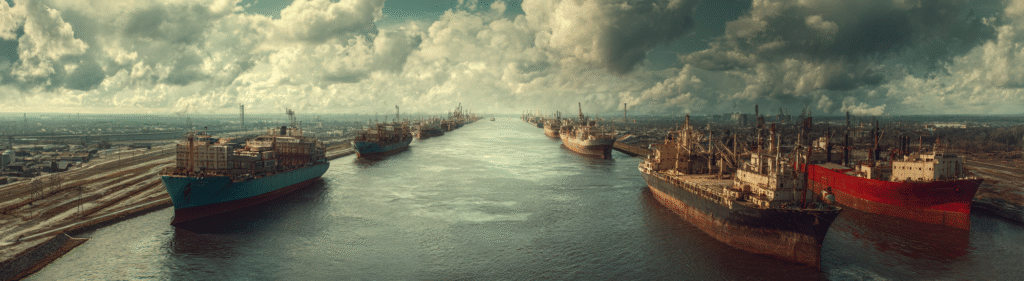
The Suez Canal remains one of the world’s most critical chokepoints, carrying about 12% of global trade. But it is far from alone. The Strait of Hormuz, the Bab el-Mandeb, the Malacca Strait — all are narrow corridors whose closure, even briefly, could ripple through supply chains and financial markets.
In 1956, Egypt’s nationalization of the canal triggered fears of economic strangulation in Europe. Today, the same fears could arise from conflict in the South China Sea, political instability around the Panama Canal, or cyberattacks targeting port logistics.
The Illusion of Control
The Suez Crisis demonstrated how quickly the presumed “owners” of a trade route can lose control. Britain and France assumed their military presence would dictate terms. Instead, they faced a U.S.-led financial squeeze, Soviet threats, and a collapse in domestic political will.
In a modern crisis, even nations with superior naval power may find their leverage limited by globalized supply chains. A blockade in one region can prompt retaliatory restrictions in another. Insurance premiums can spike overnight, rerouting ships and strangling trade without a shot fired.
The Multiplier Effect
In 1956, the mere threat of disruption sent oil prices upward and markets downward. Today, the effect would be magnified. A single grounded vessel, like the Ever Given in 2021, can cost billions in lost trade per day. Layer on geopolitical tension — say, a confrontation in the Taiwan Strait — and the fragility of the system becomes obvious.
Modern shipping operates on razor-thin margins and “just-in-time” logistics. Disruption in one chokepoint cascades into shortages, factory shutdowns, and inflation across continents.
Lessons for the Next Crisis
Diversify Routes – Just as oil pipelines eventually reduced Europe’s dependence on Suez, today’s resilience requires alternative overland corridors, expanded Arctic routes, and strategic stockpiles.
Defuse Flashpoints Early – Diplomacy, not force, ultimately ended the 1956 crisis. Investment in maritime conflict prevention may yield more than naval build-ups.
Plan for Cascades – Governments and corporations must model how a chokepoint failure interacts with other vulnerabilities — from cyber sabotage to climate-driven port closures.
The ghosts of Suez do not haunt out of nostalgia. They are reminders that the power to open or close the world’s trade arteries is both coveted and fragile — and that once those arteries constrict, even the mightiest nations may find themselves gasping for economic air.
The next crisis will have its own geography, its own actors, its own spark. But the lesson remains: control over a chokepoint is never absolute, and the price of misjudging that truth can be measured not only in ships, but in the shifting tides of global power.