By Ronan Pierce
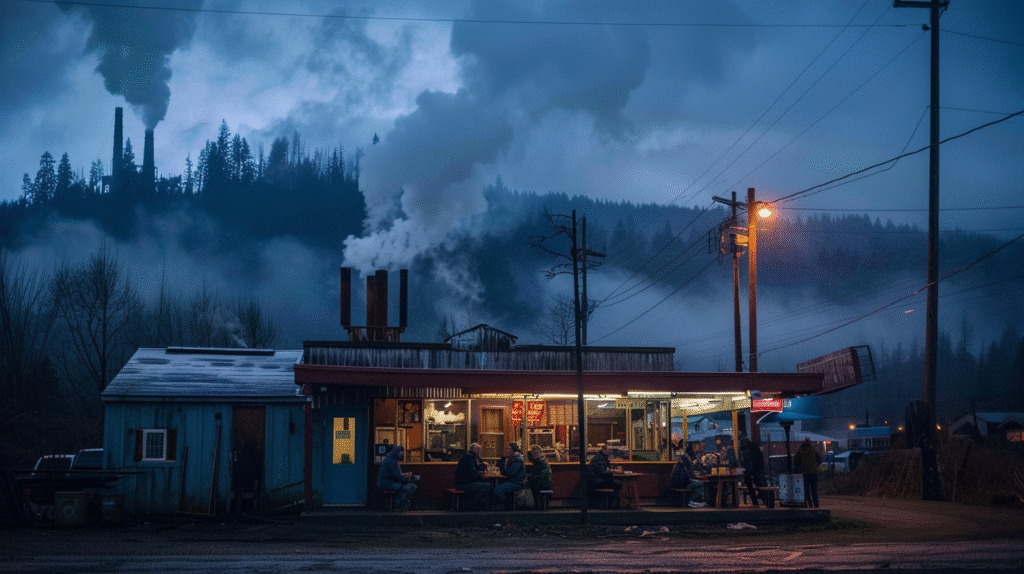
On a chilly morning in Oregon’s Cascades, the sawmill whistle that once punctuated daily life is silent. The mill gates are rusted shut, the union hall a hollowed-out shell. Yet the diner down the road still serves logging crews who work in smaller outfits, chasing thinning contracts or salvage operations after wildfire. This is what twilight looks like for timber towns: not collapse in one dramatic stroke, but a long dusk in which livelihoods fade unevenly, caught between conservation mandates and ecological decline.
When the Forest Stopped Giving
For much of the 20th century, forests were the economic bedrock of rural America’s Pacific Northwest, Appalachia, and swaths of Canada. Logs built not only houses but entire communities—schools, hospitals, Main Streets—funded by steady harvests. Then came a convergence of forces: federal protections for endangered species, the globalization of wood markets, automation in mills, and now the ecological toll of fire and beetle infestations.
What once seemed like endless abundance turned finite. Forests stopped being merely raw material and began to be seen as fragile ecosystems—carbon sinks, biodiversity reserves, symbols of a planet under stress. Towns that had grown up to cut trees suddenly found themselves asked to preserve them.
Conservation as Double-Edged Promise
Environmental protections are often framed as victory, but for timber towns they are lived as disruption. In Washington State, former loggers now work seasonal jobs thinning brush to reduce wildfire risk. In northern Maine, mill closures have pushed families to commute hours to service jobs in regional hubs. Some communities welcome the shift: eco-tourism, carbon credits, and recreation economies are filling gaps. Yet these industries rarely match the wages or stability once offered by a lifetime in the woods.
The paradox is sharp: protecting forests ensures long-term ecological survival, but it erodes the short-term survival of the very communities who once relied on them most.
Stories From the Ground
In British Columbia, I spoke with a third-generation logger whose son now guides tourists through old-growth groves rather than felling them. In Arkansas, a shuttered paper mill has left its town clinging to a single Dollar General as the last steady employer. Yet in Minnesota’s Iron Range, forest cooperatives are experimenting with hybrid economies—limited harvests combined with conservation leases, balancing work with stewardship.
These stories are not merely about trees; they are about identity. In timber towns, logging is not just an occupation but a culture, one that has shaped local politics, rituals, and self-understanding. The slow retreat of the saw leaves behind not only unemployment but disorientation.
Beyond Extraction
The future for timber towns may depend less on nostalgia than on reinvention. Regional universities are experimenting with timber-based biofuels. Indigenous communities, long excluded from forestry policy, are asserting new leadership in sustainable management. And in places where decline seems irreversible, young residents are creating new economies from the shell of the old—craft breweries in former mill warehouses, renewable energy projects on clear-cut land.
The twilight of the timber economy is real, but dusk is not the same as darkness. These towns, shaped by a century of cutting, may yet discover a second life in learning how to live with forests rather than from them.