By Dr. Liora Watterson
When churches closed their doors during the pandemic, congregations migrated online. Zoom prayer circles, livestreamed sermons, and chatroom meditations became the fabric of spiritual life. At first, these were emergency measures. Yet even as sanctuaries reopened, many communities continued to gather digitally. The experience revealed something profound: networks themselves, once dismissed as sterile conduits, are beginning to function as ritual spaces. Connectivity has become a substitute for communion.
Ritual in the Grid
Religious traditions have long insisted on presence. To worship meant to assemble, to break bread, to stand shoulder to shoulder. But the digital shift demonstrates that ritual does not vanish when bodies are apart—it mutates. The liturgy of “unmute,” the offering of prayer in a chat box, the collective silence of a muted call: these are not accidents of technology. They are emergent rituals, as patterned and repeated as kneeling or chanting.
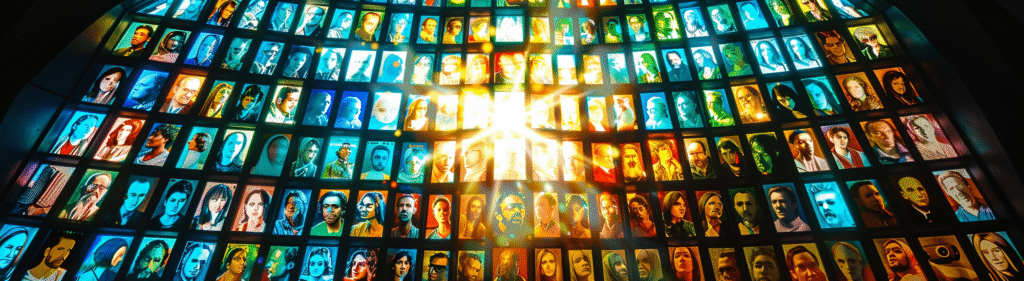
Just as medieval pilgrims once felt closeness to the divine by touching a relic, so too do modern believers describe a “real presence” when they see their community arrayed in tiny digital squares. The grid becomes a stained glass window, glowing with a hundred faces instead of saints.
Power in New Forms of Gathering
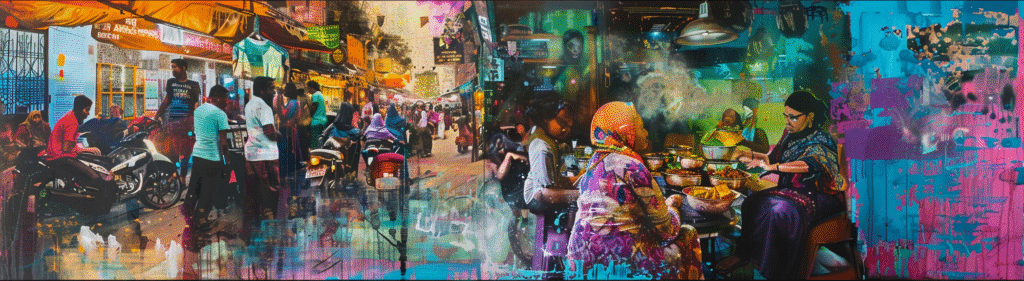
The political dimension is equally striking. Spiritual gatherings online have lowered thresholds of entry. A seeker in rural India can join a meditation group in San Francisco; an activist in Lagos can convene a theology seminar with peers in London. Hierarchies of geography and status weaken. Authority shifts from pulpits to moderators, from priests to platform hosts.
This is not unlike the Protestant Reformation, when the printing press allowed believers to bypass clerical gatekeepers. Today, fiber optics serve as the new press, reconfiguring power in ways still unsettled.
The Shadow of Substitution
And yet, substitution is not equivalence. Participants often describe a lingering hunger for presence: the smell of incense, the taste of communion bread, the tactile reassurance of another’s hand. Connectivity can replicate the form of gathering, but not always the fullness.
There is also the danger of commodification. Spiritual platforms depend on subscriptions, servers, and ad revenue. The sacred is mediated by algorithms that decide whose prayer appears first in the feed. In this sense, networks risk profaning the very rituals they now sustain.
Communion in a Connected Age
Still, we cannot dismiss what has taken root. To log on together is to enact a ritual of belonging. To feel seen, even through pixels, is to encounter something communal. If communion is, at heart, the recognition of presence beyond oneself, then sacred networks achieve a form of it—imperfect, mediated, but no less real.
The task ahead is not to scorn these digital sanctuaries, nor to accept them uncritically, but to ask: what new theologies will emerge from them? For in the weave of networks, as in the stained glass of old, human beings continue to search for the divine.