By Dr. Liora Watterson
In a converted warehouse in Lisbon, hundreds of people stand in rapture before a glowing ticker screen. Prices scroll where an altar might have stood, and when a coin surges, cheers echo like hymns. What began as financial speculation now resembles something older, more primal: a congregation. Blockchain, with its rituals, myths, and prophets, has become for many a surrogate faith. The question is not whether crypto is money. It is whether crypto is church.
Rituals of Belief
Every religion has its liturgies. For crypto communities, the ritual is the daily check of the wallet, the weekly podcast, the annual pilgrimage to conferences in Miami or Dubai. The gestures are repetitive, the vocabulary arcane: “hodl,” “gm,” “wagmi.” These are mantras, designed to bind adherents together against volatility and doubt. Anthropologists once studied prayer beads and incense; today, they study Discord servers and Twitter threads, where faith is measured in memes and market caps.
Prophets and Martyrs
Faith requires figures to embody it. In crypto, prophets range from anonymous coders like Satoshi Nakamoto to influencers who livestream with near-pastoral zeal. Martyrs, too, are canonized: those who lost fortunes in collapsed exchanges or refused to sell before the crash. Their suffering becomes cautionary parable, retold as proof that the faithful must endure. Like saints of earlier traditions, they sanctify loss by transforming it into collective meaning.
The Architecture of Awe
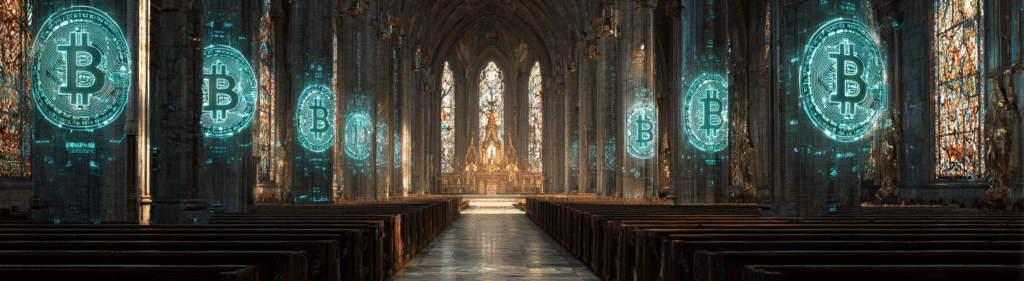
It is no accident that blockchain discourse is saturated with cathedral imagery: white papers as scripture, decentralized ledgers as sacred texts, protocols as immutable commandments. Cathedrals once housed relics and sacraments; crypto projects house tokens and smart contracts. Both offer the promise of transcendence—one of the soul, the other of wealth beyond nation-states. Step into a mining facility, with its glowing racks of servers humming in unison, and the comparison is unavoidable: a techno-liturgical space, built for awe.
Power Cloaked in Revelation
But where faith thrives, power is never far. Just as medieval cathedrals consolidated authority in bishops and kings, crypto cathedrals consolidate wealth in founders and early adopters. The claim of decentralization often hides new hierarchies: validators who hold sway, exchanges that act as modern banks, influencers who direct the crowd’s fervor. Like religion, crypto is not just about transcendence—it is about governance, about who speaks for the divine algorithm and who must obey it.
Faith in the Ledger
Perhaps all societies need myths that exceed them. For some, the blockchain’s promise of incorruptible records and borderless belonging fills the role once played by scripture. To dismiss it as mere speculation is to miss the deeper truth: people are seeking not just profit, but purpose. In the glow of their screens, they find community, ritual, and belief.
Whether these digital cathedrals endure or crumble, they reveal an ancient truth in a modern guise: when markets masquerade as faith, they remind us that money has always been more than currency. It has been creed.