By Marcus Havelock
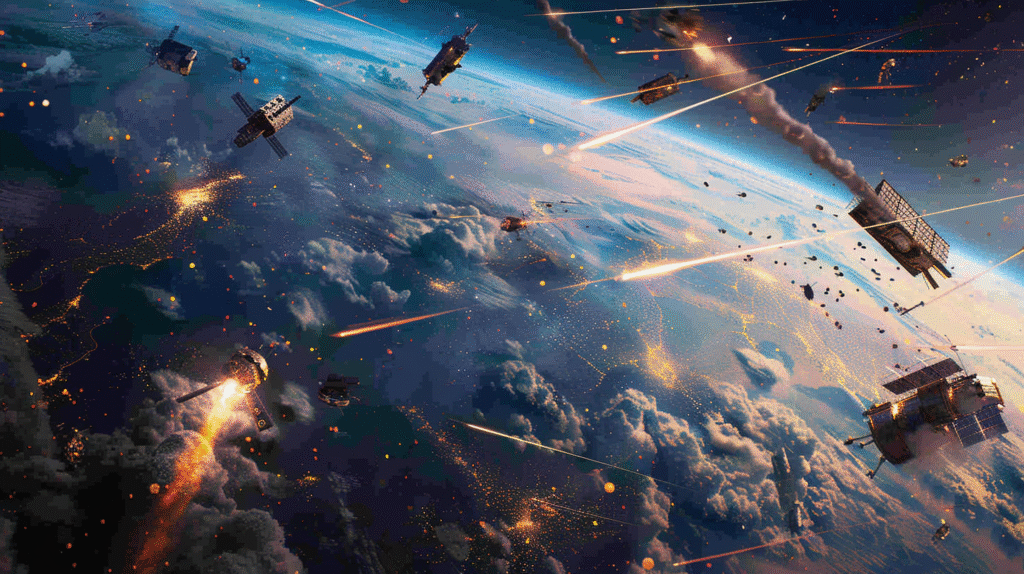
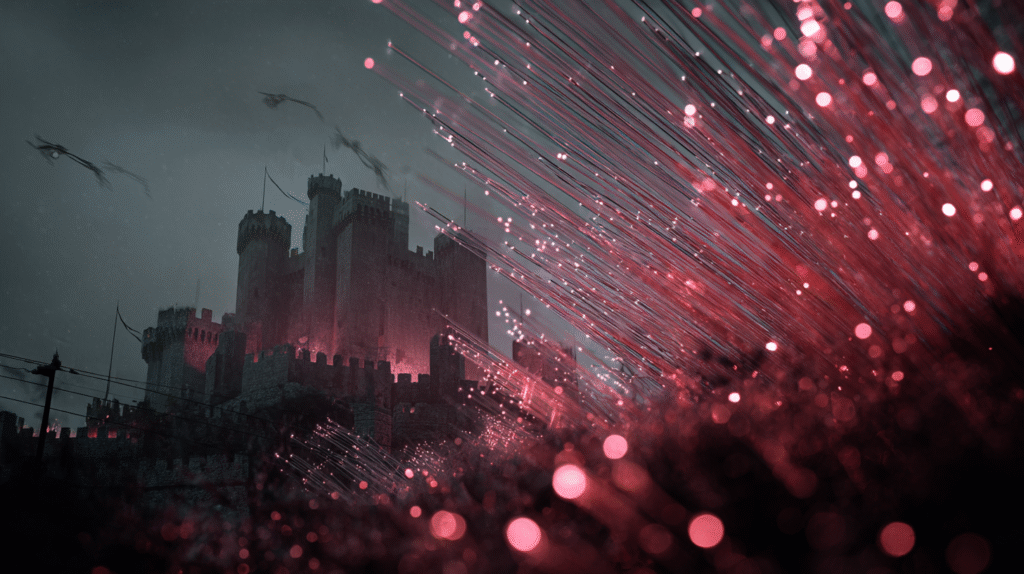
At dawn in the thirteenth century, townsfolk might wake to find the supply lines cut, the castle ringed with siege engines, and the sky thick with flaming arrows. The besieged did not always fall to conquest; more often they starved, their walls breached not by force but by attrition. Today, the walls are orbital, the arrows are lasers or jammers, and the castle in question is a satellite. The battlefield has shifted from earth and stone to low Earth orbit, but the logic of siege endures.
Space as the New Battleground
Over 7,000 active satellites now circle the planet, linking markets, militaries, and everyday lives. They carry signals for banking transactions, GPS navigation, weather forecasting, and battlefield surveillance. Their destruction—or even temporary disruption—has the potential to paralyze societies. Unlike tanks or fleets, satellites cannot be easily reinforced. Once compromised, they are marooned in the sky, cut off from repair, vulnerable to both kinetic strikes and silent interference.
It is no coincidence that recent military doctrines—from Washington to Moscow to Beijing—describe space as “contested.” The language is ancient in its implication: contested ground, fortified stronghold, siege.
Echoes of the Medieval Past
Medieval siegecraft was rarely about grand battles. It was about patience, disruption, and denial. Attackers poisoned wells, intercepted food caravans, or sowed panic within city walls. Modern orbital tactics follow the same playbook. Jamming a satellite’s signal resembles cutting off a city’s aqueduct. Launching clouds of micro-debris mimics salting the earth outside castle gates—leaving long-term devastation.
Just as castles once projected political power across landscapes, satellites now project sovereignty across borders. To disable one is not simply to strike hardware; it is to puncture the authority of the state that launched it.
Strategic Ambiguity
Unlike the medieval world, today’s siegecraft unfolds in the shadows. Few states openly admit to targeting satellites. Attribution is murky: a flicker in communication could be solar interference—or a rival’s deliberate jamming. This ambiguity is itself a weapon, allowing states to destabilize adversaries without crossing the clear threshold of war.
History offers parallels. Medieval rulers sometimes employed mercenaries to besiege cities by proxy, shielding their hands from the charge of open aggression. In our time, “patriotic hackers” and nominally private contractors play the same role in orbital conflict.
Lessons for the Present
The medieval world eventually learned that walls alone could not guarantee security. Castles were bypassed, circumvented, rendered obsolete by cannons. The lesson for the satellite age may be similar: redundancy, dispersal, and resilience will matter more than fortress-like hubs. Mega-constellations—vast swarms of smaller satellites—are one attempt to emulate the adaptability of villages rather than the vulnerability of castles.
Yet history also warns of escalation. When castles fell, so too did cities, sometimes to fire and slaughter. In the modern parallel, an uncontrolled cascade of orbital debris—the dreaded “Kessler syndrome”—could render entire layers of space unusable, devastating both military and civilian infrastructure.
A Fragile High Ground
The skies above us have become the new high ground of power politics, as laden with symbolism as the towers of medieval fortresses. They remind us that technology never fully escapes history’s gravity. The siege, ancient as it is, has simply been rewritten in orbital script.