By Dr. Mireille Chan
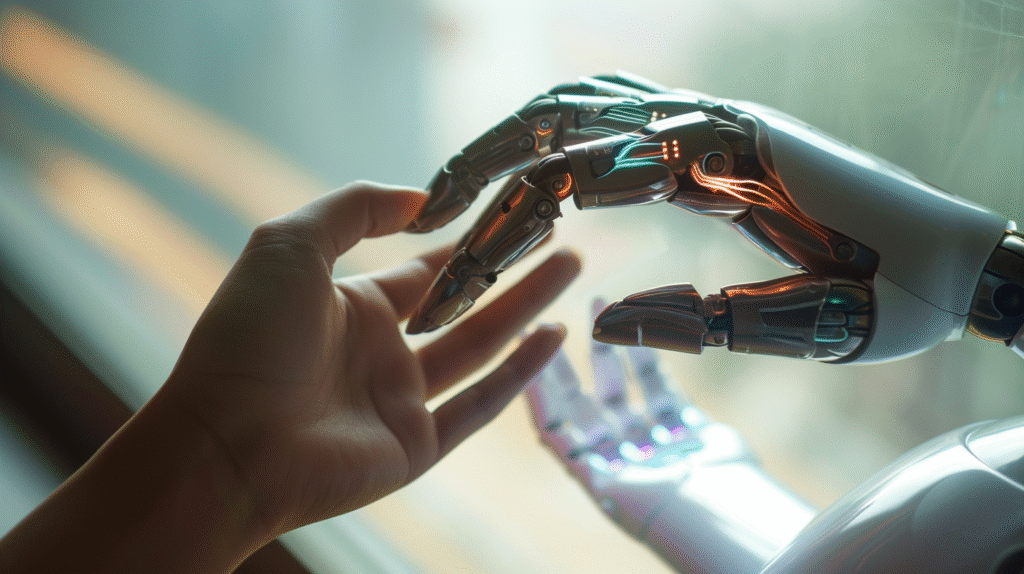
A hospice nurse holds a patient’s hand. A therapist notices the tremor in a voice. A teacher senses the quiet isolation of a child in the back row. These are moments of care that hinge not on information but on empathy. Now, artificial intelligence promises to replicate such gestures. Chatbots console the lonely, robotic pets soothe dementia patients, and customer service systems simulate concern. But what happens when empathy is no longer felt but performed by machines?
Simulated Concern
AI is remarkably good at mimicking the outward signals of empathy—tone, phrasing, attentiveness. Studies show that patients often rate chatbot-delivered responses as more compassionate than rushed clinicians. Yet this reveals a disquieting truth: we may accept the performance of empathy as a substitute for the experience itself. In the theater of care, what matters more—the actor’s feeling, or the audience’s?
The Neuroscience of Feeling
Human empathy is not mere output. It arises from networks of mirror neurons, limbic responses, and embodied histories. To feel another’s pain is to be changed by it. Machines, by contrast, parse data. They can approximate affect, but cannot undergo the visceral transformations that define human compassion. A machine may never flinch at a story of loss; it will simply calculate the probability that “I’m so sorry you’re going through this” is the correct response.
Ethical Substitutions
The danger is not that machines will fail at empathy, but that they will succeed well enough to lower our standards. If eldercare can be delegated to robots, will societies justify underfunding human caregivers? If therapy apps become the first resort, will we forget that healing requires presence, not just dialogue? Efficiency, always the lure of automation, risks hollowing out the moral core of care.
Beyond Imitation
Still, dismissing AI empathy as fraudulent may miss the point. Humans have long sought intermediaries for comfort—rituals, pets, literature. If a robotic seal calms an anxious patient, perhaps the value lies not in authenticity but in effect. The question then shifts: how do we integrate simulated empathy without eroding the dignity of real human care?
The Future of Feeling
We stand at an inflection point. AI may never feel our pain, but it will increasingly reflect it back to us. The mirror may be convincing, but it is hollow. If we confuse simulation for substance, we risk redefining empathy as nothing more than a set of signals. Perhaps the greater task is not to build machines that feel, but to build societies that refuse to let feeling be outsourced.