By Dr. Aisha Thornton
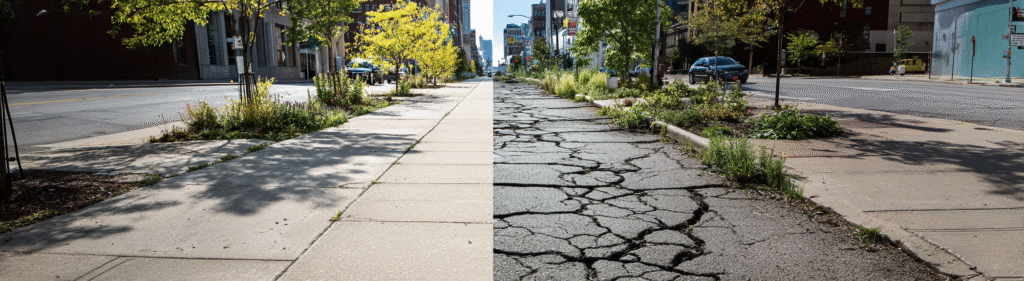
In many American cities, inequality is not only visible in income charts or school test scores. It is etched into the concrete beneath our feet. A cracked sidewalk in a low-income neighborhood, a missing curb ramp by a bus stop, a gleaming pedestrian plaza downtown — each tells a story about whose mobility is valued and whose is neglected. Sidewalks, often treated as afterthoughts of urban planning, remain one of the clearest markers of spatial injustice.
The Unequal Map of Walkability
Data from the National Highway Traffic Safety Administration show that pedestrians in low-income neighborhoods are twice as likely to be killed in traffic accidents as those in wealthier districts. The reasons are painfully simple: fewer crosswalks, poorly lit streets, and sidewalks that abruptly vanish. While affluent areas invest in “complete streets” with bike lanes and curb extensions, struggling neighborhoods often rely on crumbling infrastructure, if any at all.
Urban planning has long prioritized vehicle flow over pedestrian safety, but the inequities are not distributed evenly. In Black and Latino neighborhoods, sidewalks are narrower, crossings less frequent, and investments slower to arrive. The very geography of safety is racialized.
More Than Concrete
Sidewalks are more than slabs of concrete; they are lifelines. They determine whether a child can safely walk to school, whether an elder can access a clinic, whether a worker can catch a bus without dodging traffic. When sidewalks fail, entire communities are cut off from opportunity. A missing curb ramp is not just an inconvenience; it is an act of exclusion for wheelchair users. A street without a crosswalk is not just oversight; it is an elevated risk of death.
These failures reflect policy choices. When cities allocate resources, they often favor highly visible projects in central districts — riverfront promenades, entertainment corridors — while neglecting the quieter needs of residential blocks. The result is a form of “sidewalk apartheid”: a cityscape where movement is a privilege, not a right.
Prescriptions for Justice
The solutions are not mysterious. Equity audits of municipal budgets can highlight where pedestrian investments are lacking. Federal transportation funds could be tied to demonstrated improvements in walkability for marginalized communities. Community-driven design, where residents set priorities for sidewalk repairs and crossings, ensures that those most affected shape the infrastructure.
In Los Angeles, a landmark lawsuit pushed the city to commit over $1 billion to repair sidewalks for accessibility. Other municipalities are experimenting with participatory budgeting to direct funds toward safer crossings and lighting. These examples prove that policy can reverse decades of neglect — if there is political will.
Walking Toward Fairness
Cities often measure progress in skyscrapers built or highways widened. But the true measure of justice may be as humble as whether a child can walk to school without fear. Sidewalks, in their ordinariness, reveal the extraordinary ways cities choose who matters. To repair them is not simply to fix concrete but to dismantle the quiet geography of exclusion.