By Dr. Mateo Alvarenga
In the nineteenth century, the frontier of extraction was coal seams and gold veins. In the twentieth, it was oil fields and rare earth mines. Today, the newest frontier lies beneath the waves. As terrestrial reserves dwindle, corporations and states are turning toward the ocean floor, where polymetallic nodules, cobalt-rich crusts, and hydrothermal vents promise the raw materials of the green transition. Yet the promise of abundance conceals a deeper paradox: in the scramble to electrify the future, we risk scarring the oldest ecosystem on Earth.
A Treasure Chest in the Abyss
The seabed harbors metals critical for batteries, wind turbines, and solar panels. The Clarion-Clipperton Zone, a swath of Pacific floor between Hawaii and Mexico, holds billions of tons of nodules rich in nickel and manganese. Companies backed by states from Canada to China are rushing to secure exploration contracts through the International Seabed Authority (ISA), the obscure UN body that governs deep-sea mining. Advocates hail these resources as essential to decarbonization. But what is framed as planetary salvation also resembles history repeating: new empires built on extraction, distant from the people most affected.
The Silence of the Depths
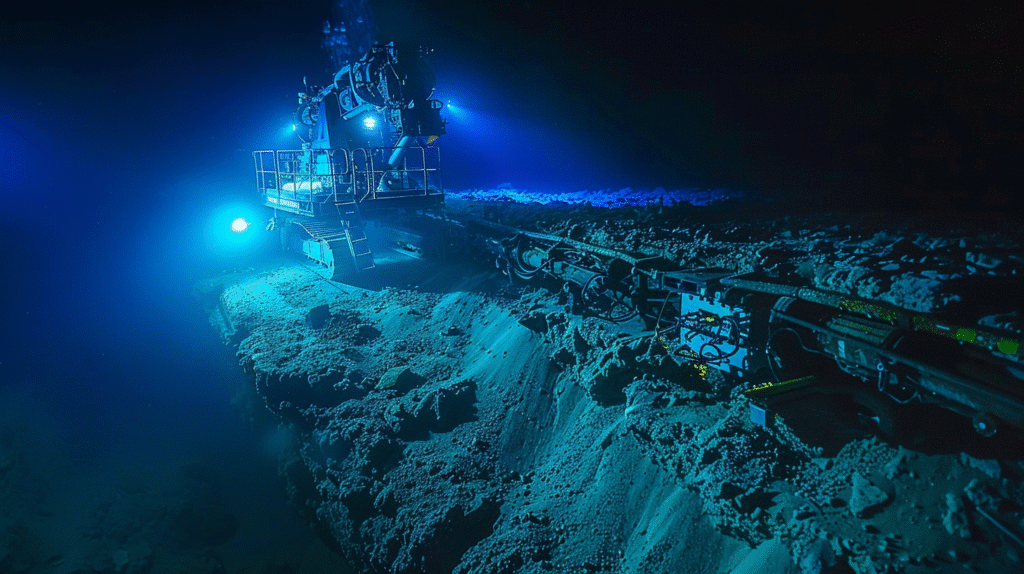
Unlike terrestrial mining, deep-sea extraction unfolds out of sight. Remotely operated vehicles dredge or vacuum nodules from depths where sunlight never reaches. Scientists warn of irreversible impacts on fragile ecosystems—vents that support unique microbial life, sediment plumes that could choke ocean currents, and noise pollution disrupting migratory species. Because baseline data is scant, damage could remain invisible until it is permanent. In this sense, the ocean floor becomes both laboratory and sacrifice zone, a silent ledger of costs not yet tallied.
Geopolitics Below the Surface
Ocean mining is not merely an ecological question—it is a geopolitical one. Small Pacific island nations, whose identities and economies are bound to the sea, find themselves courted by mining firms and sidelined in decision-making alike. For countries like Nauru, the promise of royalties offers short-term relief from economic precarity. For industrial powers, control of seabed metals is a hedge against China’s dominance in rare earth markets. The ISA, tasked with ensuring the “common heritage of mankind,” has become an arena where sovereignty, profit, and survival collide.
Whose Ocean, Whose Future?
Indigenous leaders from Polynesia to Alaska remind us that the ocean is not empty space but a living relation. To treat it as a storehouse of metals is to erase centuries of cultural stewardship. Calls for a moratorium on deep-sea mining echo these traditions, demanding that precaution take precedence over profit. The choice is stark: will humanity treat the ocean as capital to be liquidated, or as commons to be sustained?
A Frontier Worth Refusing
The history of extraction teaches that frontiers rarely close once opened. Saltwater capital may fund the green transition, but it risks entrenching the same logic that created the crisis: endless growth justified by technological salvation. Perhaps the more radical act is refusal—to imagine futures where decarbonization proceeds not through new sacrifice zones, but through restraint, recycling, and justice. If the seabed is the last frontier, it is also the place where humanity must finally decide whether every frontier must be crossed.