By Prof. Naomi Klineberg
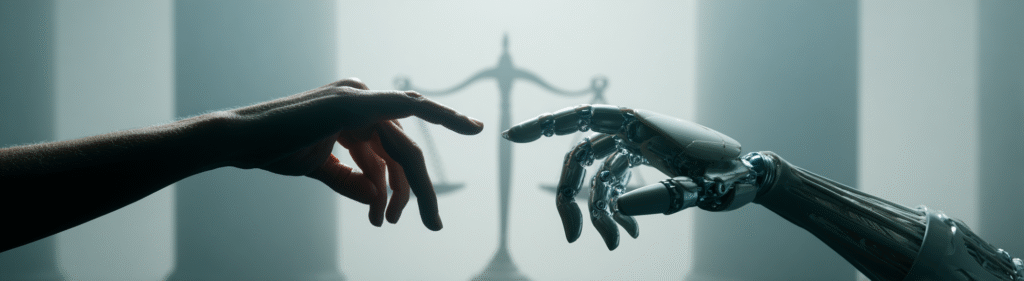
If a machine acts, who bears the blame? The programmer who wrote its code? The company that deployed it? Or, in some conceivable future, the machine itself? As artificial intelligence becomes more sophisticated, the moral terrain grows murkier. The law has long assigned responsibility to human agents, but as AI systems generate outcomes that even their designers struggle to predict, the boundaries of accountability strain. Should rights be extended to robots? Or are we better served by sharpening the duties of their creators?
The Case for Robot Rights
Some argue that once AI systems exhibit autonomy — the ability to make decisions without direct human input — they deserve moral consideration. We do not punish animals for biting, yet we recognize their capacity for suffering and afford them certain protections. Could a self-learning AI, capable of experience-like states, deserve something similar? Extending rights, in this view, is less about holding robots accountable and more about preventing their exploitation as mere tools.
But this approach risks anthropomorphizing code. Unlike humans or animals, machines do not suffer in any recognizable sense. To treat them as moral patients may dilute the very meaning of rights.
Duties Without Displacement
An alternative view insists that responsibility must remain squarely with human designers and deployers. Algorithms may “decide,” but they do so within architectures built by people and organizations. To shift accountability onto machines is to excuse negligence in boardrooms and laboratories. After all, a biased hiring algorithm does not create itself; it is trained on data curated by human hands, and it is implemented by institutions making choices.
The danger of speaking of “robot responsibility” is that it provides a convenient scapegoat. Moral language migrates from those who wield power to the systems they unleash.
Shared Responsibility or Diffused Responsibility?
There may be a middle ground: a framework of shared responsibility where designers, regulators, and users all hold overlapping duties. But shared responsibility carries its own risk: diffusion. When everyone is accountable, no one is. The history of industrial accidents teaches us that responsibility must be both collective and traceable, lest it dissolve into abstraction.
The philosophical challenge, then, is not merely to ask whether robots should have rights, but how to design systems that keep human agents visible in the chain of accountability.
The Deeper Question
Perhaps the most urgent inquiry is not about robots at all, but about us. In constructing intelligent systems, are we trying to offload not just labor but blame? The temptation to grant robots rights may reflect a deeper wish to absolve ourselves of duties.
The Socratic task is to keep asking: What kind of moral community do we wish to inhabit? One where machines are recognized as citizens, or one where humans retain the burden of responsibility? The answer may shape not only our technologies, but the very meaning of justice in a digital age.