By Dr. Celeste Rahman
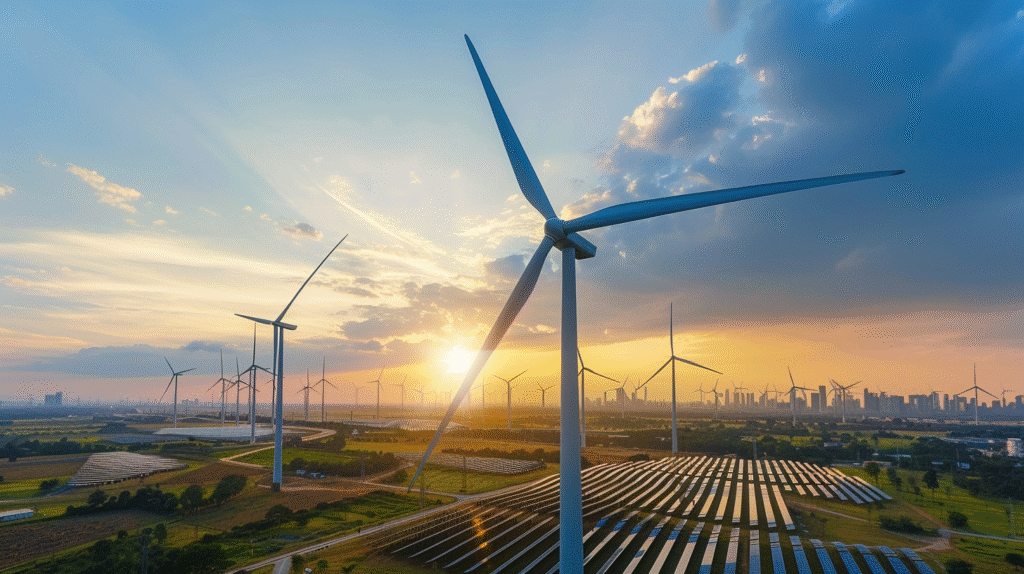
The conversation about renewable energy trends 2025 has shifted from abstract climate goals to concrete changes in how our electricity systems operate. What was once an ambitious vision is now visible in everyday life: wind turbines along coastlines, solar panels glinting on rooftops, and the silent presence of batteries balancing supply and demand. These grid upgrades are not only reshaping the physics of energy distribution, but also transforming public perceptions of climate risk. To make sense of these changes, it helps to think in familiar terms: if fossil fuels were once a diet of fast food, renewable energy is the slow, steady nutrition that sustains us—provided we manage storage and distribution wisely.
Why 2025 Marks a Turning Point
Every year brings announcements of new wind and solar installations, but 2025 is different. Several dynamics are converging at once: offshore wind projects moving from demonstration to industrial scale, battery storage spreading from pilot to portfolio level, and grid operators rethinking transmission as climate-resilience infrastructure. The International Energy Agency’s mid-year update shows wind and solar together rising from ~15% of global generation in 2024 to ~17% in 2025, on track for ~19% in 2026—an unprecedented climb for two technologies in such a short window.
The significance lies not just in the numbers, but in the systems adapting to handle them. Power grids built for predictable flows of coal or gas are being redesigned for the variability of wind and solar. It’s like turning a one-way street into a complex intersection where traffic lights must constantly adapt.
The Pantry Analogy: Why Storage Matters
If electricity generation is the grocery store, battery storage is the pantry that keeps your household running between trips. Without a pantry, meals depend entirely on what’s immediately available—a risky strategy when supply is unpredictable. In energy terms, without storage, renewable power remains vulnerable to fluctuations in weather.
Lithium-ion has been the workhorse, but 2025 attention is shifting toward long-duration energy storage (LDES) that can deliver power beyond the typical four-hour window. The U.S. Department of Energy outlines how innovations in non-lithium chemistries, advanced thermal systems, and new manufacturing approaches can push costs down, expanding use cases from daily cycling to multi-day reliability in its LDES report. States are already moving: California’s LDES program is funding demonstrations specifically to diversify beyond lithium-ion and support a more reliable grid.
The point is not storage for storage’s sake. It’s about converting variable renewable output into dependable, schedulable capacity—so that windier nights and sunnier afternoons show up as steady service when people actually need it.
Transmission Lines as Climate Infrastructure
Energy debates often focus on generation—wind farms, solar fields, hydro dams. But the most decisive battles in 2025 involve the wires themselves. Expanding transmission capacity has become a bottleneck, delaying renewable projects already approved and financed. In the United States, the Federal Energy Regulatory Commission’s Order No. 1920 requires long-term, regional transmission planning and clarifies cost allocation—an attempt to move beyond fragmented utility footprints and out-of-date assumptions.
Here, the analogy shifts from pantries to highways: even the most efficient vehicles cannot deliver food if the roads are blocked. Similarly, clean power must travel across vast distances—often from rural generation sites to urban demand centers—and without upgraded transmission, bottlenecks persist and projects stall.
Data Centers, Demand, and the Reliability Narrative
A new wrinkle in renewable energy trends 2025 is demand growth from electrification and digital infrastructure. Electric vehicles, heat pumps, and especially AI-enabled data centers are pushing electricity consumption upward after years of stagnation in some regions. The IEA’s Global Energy Review 2025 underscores that meeting this new demand without triggering higher emissions depends on how fast renewables, storage, and wires scale together.
High demand has sharpened an ongoing debate: does a grid with more wind and solar become less reliable? The answer hinges on portfolio design. With diverse renewable resources, firm clean capacity where needed, storage with enough duration, and robust transmission, a high-renewables grid can be both cleaner and more resilient. That’s why planning rules like FERC’s and targeted LDES initiatives like California’s matter: they turn the theoretical reliability of a portfolio into practical, dispatchable reality.
Public Perception: From Risk to Reliability
Renewable energy trends in 2025 are not only technical milestones; they are cultural ones. For decades, surveys showed skepticism that wind and solar could provide reliable power. That perception continues to evolve. A Pew Research Center survey found overwhelming support among Democrats for expanding renewables, with the broader public debate increasingly tied to pocketbook issues and national security framing.
This shift is profound. Energy policy once lived in technical committees and regulatory filings. Today it shapes elections, consumer choices, and even lifestyle identities. To install rooftop solar is not only an economic decision but also a symbolic gesture of resilience, akin to stocking an emergency kit before hurricane season.
Equity and Access in the Renewable Transition
Yet optimism must not obscure disparities. While wealthier households install solar panels and batteries, lower-income communities often remain locked into high energy bills and unreliable infrastructure. Globally, the picture is even starker: hundreds of millions still lack electricity altogether. As a colleague argues in The Grid Divide, electrification itself—not GDP—is becoming a defining measure of national power this century, reframing energy access as both development strategy and geopolitical currency.
Policies in 2025 are beginning to grapple with this. Programs for community solar, rural microgrids, and targeted subsidies are expanding, but the challenge remains: can renewable transitions avoid reinforcing the inequalities of the fossil era? Transmission routing and cost allocation, for example, can either replicate old burdens or redistribute benefits. Likewise, siting rules can either create new “sacrifice zones” or bring jobs and cleaner air to the communities that have carried pollution the longest.
Offshore Wind and the Supply-Chain Lesson
Offshore wind illustrates the learning curve of clean-energy industrial policy. After a choppy period of inflation, contract renegotiations, and supply-chain setbacks, 2025 is seeing steadier procurement frameworks and clearer pipeline visibility in several markets. The global lesson is straightforward: long-lived, capital-intensive projects need policy certainty, port infrastructure, interconnection capacity, and a domestic supplier base to weather macroeconomic swings. When these elements line up, the cost and schedule risks come back down—and the resource’s unique profile (stronger, steadier winds at sea) becomes a valuable hedge against onshore variability.
Storage Beyond the Four-Hour Box
If 2015–2022 was the era of four-hour lithium-ion for evening peaks, renewable energy trends 2025 expand the conversation to multi-hour and multi-day needs. That includes novel electrochemical approaches (e.g., sodium-based systems), thermal storage paired with industrial heat, and iron-air concepts moving from pilots to first commercial deployments. The DOE’s LDES roadmap emphasizes driving down levelized costs across these use cases so that planners can treat storage like a modular reliability resource rather than a boutique add-on.
Permitting, Community Consent, and Better Projects
The speed question often reduces to “permitting is slow,” but communities are telling us something more nuanced: process and benefits matter. Projects that engage early, share economic upside locally, minimize ecological impacts, and design for visual and acoustic concerns move faster and last longer. Transmission in particular benefits from corridor reuse (rail, highway) and from designs that bundle community benefits with ratepayer savings. Order 1920 pushes planning forward at the regional scale; translating plans into social license remains a craft requiring humility and co-design.
Climate Risk Communication: Making the Invisible Visible
Communicating risk has always been one of the hardest parts of climate policy. Carbon dioxide is odorless, the grid is invisible, and impacts unfold over decades. The promise of renewable energy in 2025 is that risk becomes tangible. When wildfires threaten transmission lines, storage solutions suddenly matter. When urban heat waves push air-conditioning demand to extremes, grid resilience becomes a kitchen-table conversation.
Analogies help. Comparing storage to pantries makes capacity intuitive; comparing grid reliability to public health makes prevention legible. The infrastructure we don’t notice is often the infrastructure that keeps us safe.
Conclusion: From Technical Fix to Social Contract
Renewable energy trends 2025 show that the energy transition is no longer about isolated technologies. It is a redesign of social contracts: who pays, who benefits, and who bears risk. Offshore wind farms, next-generation batteries, and new transmission corridors are engineering marvels, but their success depends on public trust and equitable distribution.
The year 2025 will likely be remembered not for a single breakthrough, but for the moment when clean energy stopped being a futuristic promise and became the ordinary expectation. Like turning on a light switch without thinking, renewable power will be judged not by novelty but by reliability. And in that quiet shift lies the real climate future we are building together.