By Dr. Leila Mbaye
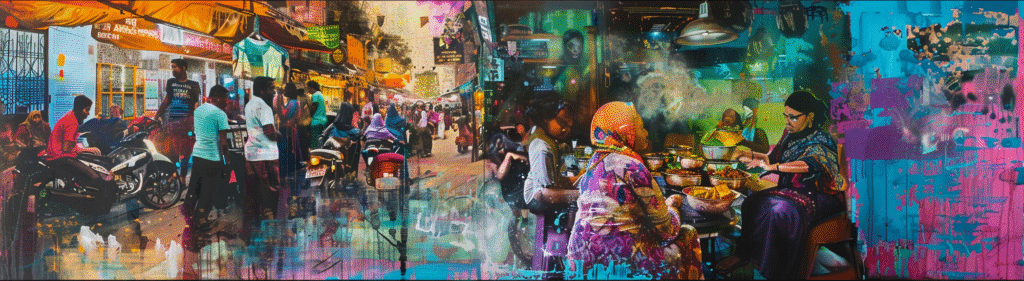
On a Sunday in Queens, a Senegalese grandmother ladles thieboudienne onto plates for a dozen relatives and neighbors. Across the Atlantic, in Paris, a Malian hip-hop collective remixes Bambara proverbs over trap beats. In Doha, a Filipino nurse livestreams karaoke night for friends in Manila. Each moment is small, ordinary. Yet together, they form the architecture of belonging—rituals that stitch community across oceans and generations
Homes in Motion
Migration has always been more than departure and arrival. It is a continual negotiation of home. For those who leave, the homeland lingers—in recipes, languages, lullabies. For those who remain, remittances, calls, and digital messages bring the diaspora back into daily life. The result is not one home but many, layered and overlapping, shifting as people move.
Anthropologists call this “transnationalism,” but in lived terms it is simpler: home becomes portable. It travels in spice jars tucked into suitcases, in WhatsApp voice notes, in prayers whispered toward a remembered horizon.
The Politics of Belonging
Yet belonging is not just cultural; it is political. Migrant communities carve out spaces in host societies that may welcome their labor but question their presence. A Ghanaian market in London, a Dominican baseball league in the Bronx—these are not only cultural enclaves but acts of assertion: we are here, we belong, and we shape the city too.
At the same time, governments oscillate between courting and controlling diasporas. Some countries extend voting rights abroad, framing the diaspora as a resource. Others restrict dual citizenship, fearing divided loyalties. For migrants, belonging is not just a feeling; it is a contested status, subject to shifting laws and suspicions.
Rituals of Continuity
In the face of these tensions, ritual becomes anchor. Weddings celebrated twice—once abroad, once at “home.” Religious festivals live-streamed across time zones. Even mundane practices, like cooking national dishes on weekends, become rituals of continuity. They remind both migrants and their children that belonging does not require singularity. One can be both here and there, local and global, without contradiction.
These rituals also evolve. A mosque in Berlin adapts sermons to German law while maintaining Arabic liturgy. Caribbean carnival parades in Toronto fuse traditional costumes with global pop soundtracks. Belonging is never static; it is continuously remade.
Futures in the Making
The story of diasporas is often told in terms of loss—loss of roots, of language, of homeland. But seen differently, diasporas are laboratories of the future. They test new ways of being together, across difference, across distance. They show that belonging is not a fixed territory but a set of practices, chosen and renewed.
As migration continues to shape the 21st century, these diasporic futures will matter to us all. They reveal that the question is not where we come from, but how we build homes—plural, overlapping, resilient—in a world forever in motion.