By Dr. Leila Mbaye
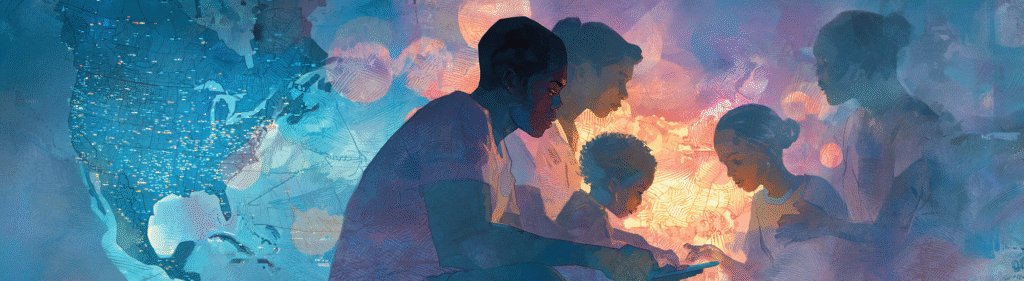
On a Friday night in Paris, a Senegalese family gathers around their television to watch a Nollywood drama. In Toronto, Somali teenagers swap memes from a Turkish historical epic. In São Paulo, a second-generation Korean immigrant queues up a K-drama with Portuguese subtitles. None of these households share a passport, but all share something harder to legislate: a sense of belonging forged through story. In the age of streaming, diaspora communities are finding new homelands—not in territory, but in catalogues.
Screens as Surrogate Soil
For much of the 20th century, the nation-state anchored identity through schools, flags, and borders. For diasporas, identity was carried in suitcases: in recipes, photographs, and visits “back home” when possible. Today, platforms like Netflix, Amazon, and regional upstarts have globalized access to cultural production. A series filmed in Lagos can reach cousins in London within hours. The screen becomes a kind of surrogate soil—narratives growing roots across continents, nurturing communities who may never step foot in the land of origin.
The Politics of Representation
Yet streaming is not a neutral archive. Algorithms determine what diasporas see of themselves. A Palestinian student in Berlin may search for “home” and find her people portrayed mainly through conflict. A Mexican-American family may find narco-dramas outnumbering comedies or romances. What the algorithm amplifies, it normalizes. The politics of representation migrate from the hands of nation-states to the hands of corporations, with profound consequences for how dispersed peoples imagine themselves.
Stories as Soft Power
Governments are not blind to this shift. South Korea has long promoted its dramas and pop music as national exports, a strategy of cultural soft power now dubbed the “Korean Wave.” Turkey finances historical epics that cast Ottoman rule in a favorable light, resonating with diasporas across the Middle East and beyond. These stories shape global perceptions as effectively as embassies or treaties. For diasporas, the effect is doubly strong: the homeland enters the living room nightly, reconstituting nationhood through narrative.
Community in the Comments
The sense of homeland is not only on the screen, but in the spaces around it. Comment threads, fan groups, and reaction videos become gathering grounds. Here, viewers argue over accents, swap cultural references, and sometimes contest the portrayals themselves. A digital commons forms where identity is debated, remixed, and claimed. The homeland, once imagined through maps, is now sustained through broadband.