By Yara Bennington
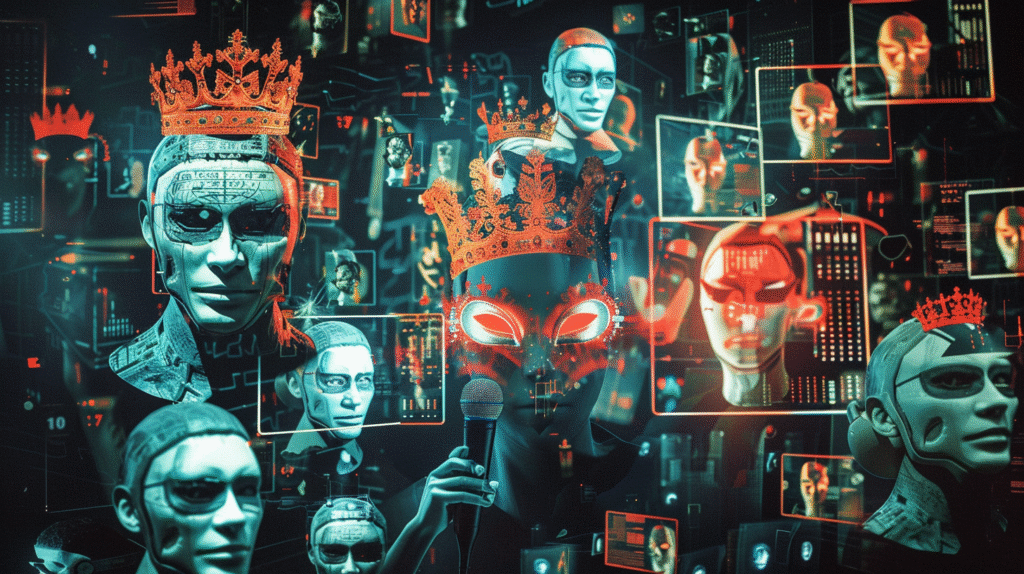
In medieval Europe, a crown conferred legitimacy. In the twentieth century, a suit and title sufficed. Today, authority might wear cat ears, wield a ring light, or speak through a pseudonym known only to Discord followers. The age of digital personas has scrambled the symbols of legitimacy, forcing us to ask: when an avatar speaks, who—or what—commands our trust?
From Pseudonym to Platform
Anonymity once meant marginality: pseudonyms were the tools of dissidents, satirists, or those ducking censorship. Now they are status symbols. “VTubers” draw millions while concealing their faces; anonymous Substack writers pull six-figure incomes; entire influencer empires rest on avatars more recognizable than their creators. The irony is sharp: in a world obsessed with authenticity, power is increasingly wielded through deliberate artifice.
Symbols That Stick
Digital authority often arrives in forms that once seemed unserious. A blue checkmark, once a bureaucratic verification badge, became shorthand for cultural capital—until it was sold. Memes, dismissed as disposable jokes, now carry ideological heft, shaping elections as effectively as campaign speeches. Even usernames, from ironic handles on Reddit to monikers in online games, accrue reputational weight. What looks trivial is often the architecture of influence.
The Irony of Legitimacy
If legitimacy once derived from institutions—parliaments, courts, universities—it now often stems from virality. A thread that “lands” on Twitter can shift policy faster than a white paper. A livestreamed takedown may eclipse months of investigative reporting. Authority here is performative: to command attention is to command power, at least temporarily. But the instability is built-in. Avatars can be deleted, platforms implode, algorithms change. Sovereignty by clout is fickle, but no less consequential.
Who Benefits From the Mask?
The recoding of authority through avatars has liberatory potential. Marginalized voices can sidestep prejudice by speaking through a persona. Whistleblowers can reach audiences without retaliation. Yet the same dynamics empower disinformation networks and corporate sock puppets. A pseudonym can mask the powerless or the powerful, the dissident or the demagogue. The mask, in digital life, is never neutral.
Beyond Authenticity
Perhaps the mistake is to treat avatars as deception. In practice, they are the new regalia—symbols that confer legitimacy not by revealing identity but by curating it. Authority has always relied on performance: judges in robes, generals in uniform, CEOs on earnings calls. Online, the performance simply takes different forms, with different risks. To navigate the twenty-first century, we must learn to read avatars not as lies, but as signals—ironic, unstable, and deeply political.