
By Dr. Mireille Chan
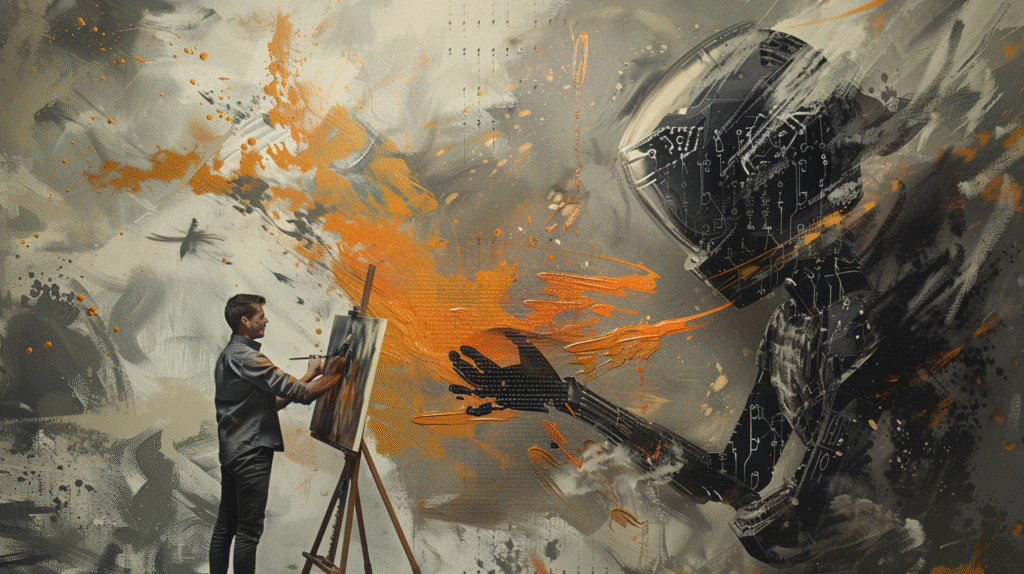
The debate over AI-driven art creation ethics has intensified as algorithms generate works once considered the exclusive domain of human imagination—raising urgent questions about responsibility, authenticity, and the erosion of creative labor. Once confined to experimental labs, AI-driven art platforms now sit on the desktops of hobbyists and the dashboards of global advertising firms, collapsing boundaries between professional artistry and mass automation. What is at stake is not only who gets credit, but also how society defines authorship, ownership, and even the purpose of art in a world where machines increasingly perform the act of creation.
From ownership and authorship to bias, environmental impact, and governance, the rapid advance of AI art forces us to rethink not just what art is but what it ought to be. This essay explores how ethical considerations must follow innovation, not trail behind it, offering a panoramic view of the dilemmas that AI art brings to culture, labor, and policy.
AI-driven art creation ethics and ownership
The question of ownership is foundational. Traditional copyright frameworks remain tethered to human authorship. In 2023, a federal appeals court ruled that Stephen Thaler’s AI system DABUS could not hold copyright over images it produced, reaffirming that U.S. law recognizes only human creators, as reported by Reuters.
But the terrain is murkier when AI operates as a collaborator. Consider the case of artists who feed prompts, tweak outputs, and curate thousands of generated variations. The U.S. Copyright Office has acknowledged the difficulty of determining whether human input is sufficient to claim authorship, sometimes rejecting works created with MidJourney or Stable Diffusion, a point highlighted in the Regulatory Review. This ambiguity has left artists exposed, unable to guarantee that their works will be protected or recognized in the same way as traditionally produced pieces.
Ownership debates also extend to training data. Many AI systems have been built by ingesting millions of copyrighted images scraped from the web. Artists whose works are repurposed without consent argue that this constitutes theft. Ongoing lawsuits, such as Getty Images’ case against Stability AI, will determine whether datasets themselves are unlawful or whether AI firms can rely on “fair use” arguments. The outcome may redefine intellectual property for decades.
Bias, representation, and social harm
AI art is not neutral. The datasets on which systems are trained often contain the biases of the societies that produced them. Researchers have found that prompts for “nurse” or “teacher” yield overwhelmingly female representations, while prompts for “CEO” or “scientist” return mostly male images. Worse, racialized stereotypes appear when prompts include descriptors like “criminal” or “beauty.” An overview of these issues by IEEE Computer Society shows how such biases perpetuate structural inequality.
The reproduction of bias in AI-generated images has real-world consequences. Cultural depictions shape perceptions, and AI risks amplifying inequities already present in society. Artists from marginalized communities also find their distinctive styles replicated without recognition or compensation, a phenomenon some Indigenous creators describe as “data colonialism.”
To address these harms, transparency measures have been proposed. Watermarking AI images, requiring provenance disclosures, and establishing opt-out registries for artists are among the suggestions discussed in scholarly guidelines from CSB/SJU Libraries. Yet implementation remains inconsistent, and AI firms often prioritize rapid innovation over ethical responsibility.
Environmental and labor considerations
The hidden costs of AI art extend to environmental and labor concerns. Training large-scale image generation models requires immense computing power. A 2024 study found that some systems consume more electricity in training than dozens of households use in a year, raising serious concerns about emissions. A recent arXiv paper details how the expansion of creative AI platforms may exacerbate the technology sector’s already heavy carbon footprint.
Labor displacement is equally pressing. Stock photo providers, illustrators, and graphic designers find their markets undercut as clients turn to cheaper AI-generated alternatives. A 2025 feature on Medium warned that creative professionals risk being sidelined as machine-made content floods the market, with human labor devalued in the process (Medium).
Some optimists suggest that new roles, such as “AI art directors” or “prompt engineers,” will emerge. Yet these opportunities are unlikely to replace the thousands of jobs disrupted. The imbalance raises deeper questions about how societies value human creativity and whether mechanisms such as universal basic income or artist subsidies should cushion the transition.
Redefining authorship and creative collaboration
While critics warn of erasure, some artists embrace AI as a collaborator. Refik Anadol, known for his immersive installations, has described AI not as a replacement but as an “extension of imagination.” His work demonstrates that AI can be integrated into artistic practice without displacing human agency, as profiled by the Observer. Musician Holly Herndon has gone further, licensing her voice through a model that allows fans to co-create with her while ensuring credit and compensation remain intact.
These practices challenge the romantic notion of the solitary artist-genius. Creativity becomes distributed: the human provides vision and intent, the AI supplies generative capacity, and the audience participates in co-production. Yet even in collaborative models, the ethics remain unsettled. Should AI be named as co-author? Should developers of the algorithms share credit—or blame?
Philosophers of mind suggest that authorship may no longer be singular but layered, involving networks of human and machine contributions. Unless legal and cultural norms evolve, disputes over credit will continue to breed mistrust.
Historical parallels: from photography to sampling
To contextualize today’s debates, it helps to remember earlier disruptions. When photography emerged in the 19th century, critics argued it would destroy painting. Instead, painting adapted, and photography itself came to be recognized as an art form. Similarly, the rise of digital sampling in music prompted lawsuits and moral panic in the late 20th century, yet sampling is now accepted as legitimate creativity.
AI art may follow a similar trajectory: initial resistance, gradual adaptation, and eventual integration. Yet unlike photography or sampling, AI art blurs authorship more radically, since the “tool” is itself generative and semi-autonomous. Ethics must therefore grapple with the unprecedented agency of algorithms.
Governance and emerging ethical frameworks
Governance frameworks are beginning to take shape. UNESCO’s Recommendation on the Ethics of Artificial Intelligence emphasized transparency, accountability, and human oversight, urging states to adopt these principles globally (UNESCO). The European Union’s AI Act, finalized in 2024, designates generative systems as “high-risk” when used in sensitive cultural or political contexts, requiring audits and documentation.
Industry bodies like the Partnership on AI have articulated voluntary guidelines, advocating fairness and explainability. Yet critics argue that self-regulation often prioritizes corporate interests. Scholars such as Geert Hofman recommend ethical compasses tailored to creative industries, stressing responsibility, anticipation, and reflection, as outlined in his arXiv paper.
Civil society is mobilizing too. Artist collectives are pushing for licensing schemes that ensure compensation when their works are used to train AI. Museums debate whether to display AI-generated works without human attribution. And grassroots groups experiment with decentralized governance models, allowing communities to determine how AI tools are deployed locally.
Cultural perception and authenticity
Beyond law and policy lies the question of cultural meaning. What do audiences value in art? If an AI can replicate the brushstrokes of Van Gogh or the timbre of Nina Simone, does the absence of lived human experience matter? Many argue yes: authenticity is inseparable from context. An algorithm can simulate suffering but cannot feel it; it can approximate joy but cannot live it.
Others counter that audiences have always embraced illusions. Theater, cinema, and digital effects all rely on artifice. What matters is not whether the creator suffered but whether the work resonates. This tension between authenticity and affect may define cultural debates for decades to come.
Already, collectors question whether AI art holds long-term value. Some buy it as novelty, others as speculation, but skepticism persists about whether machine-made works can endure as cultural touchstones. The debate echoes conversations within Artificial Opinion, such as The Empathy Machine: Can AI Ever Truly Feel Our Pain?, which probes how simulated affect challenges our valuation of human experience.
Global perspectives
The ethics of AI art creation differ across regions. In China, state-backed initiatives promote AI art as part of national technological leadership, often prioritizing innovation over individual rights. In Europe, stronger data protections shape cautious adoption, while the EU AI Act sets a regulatory tone for global markets. African artists, meanwhile, have voiced concerns that AI trained primarily on Western datasets sidelines local aesthetics, reinforcing cultural imperialism.
These global variations highlight that ethics cannot be one-size-fits-all. Any framework must address not just legal rules but also cultural values, economic disparities, and geopolitical realities. Without inclusive dialogue, AI art risks reinforcing global inequities rather than bridging them.
Toward a healthy creative ecosystem
To ensure that AI enriches rather than diminishes creativity, multiple stakeholders must collaborate. Artists should retain control over how their works train models, perhaps through licensing platforms or collective bargaining structures. Developers should embed traceability mechanisms, allowing audiences to see whether and how AI contributed. Policymakers should enforce transparency and accountability while ensuring innovation remains accessible.
Educational institutions can play a crucial role by teaching AI literacy. Just as film schools contextualized cinema as both art and technology, art schools must now integrate AI training to prepare the next generation of creators. Without these interventions, AI risks overwhelming cultural ecosystems with undifferentiated output, eroding trust, and destabilizing livelihoods.
Crafting ethical futures in AI and art
The stakes of AI-driven art creation ethics extend beyond technical novelty: they shape culture, identity, and the role of human creativity itself. Moving forward requires more than laws—it requires a shared vision that honors artistic integrity, social equity, and ecological responsibility.
Only through concerted, multidisciplinary collaboration—across artists, technologists, institutions, and policymakers—can we ensure that machine-made masterpieces enrich our world rather than diminish it. In this moment of transition, the challenge is not merely to regulate AI art but to cultivate an ethical imagination equal to the technologies we have unleashed.
