By Ronan Pierce
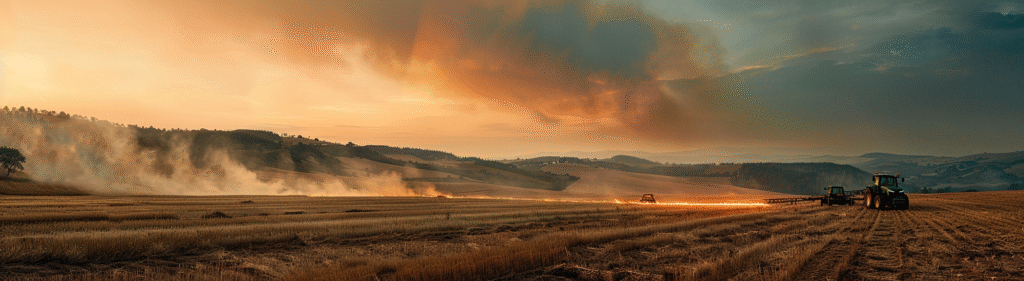
On the edge of California’s Central Valley, the fields are golden and dry by late summer, a brittle patchwork stitched together by irrigation canals. For generations, the harvest season here has ended with community festivals—parades of tractors, pie contests, and proud displays of yield. But in recent years, celebration has given way to vigilance. As the last trucks roll out of the fields, residents scan the horizon for smoke. The season of bounty is now immediately followed by the season of fire.
When Fire Follows the Crop
Farm towns are built around cycles: planting, tending, harvesting, resting. Wildfire has disrupted that rhythm. In places like Oregon’s Rogue Valley or Colorado’s Front Range, entire communities now live with the expectation that flames will lick at their borders every summer or fall. The blaze no longer feels like an interruption; it feels like a permanent chapter in the rural calendar.
For farmers, the timing is cruel. Months of labor can be undone overnight. Hay bales ignite like tinder, orchards are scorched beyond recovery, and livestock are lost in panicked evacuations. Insurance payouts rarely cover the true cost, leaving families to rebuild with fewer resources each year.
A Town Rebuilt in Ash
In 2020, the town of Talent, Oregon, saw hundreds of homes and businesses destroyed by wildfire. Rebuilding has been slow, hindered by rising construction costs and lingering smoke damage. Residents describe a haunting sense of impermanence: “We put up new fences,” one farmer told me, “but we don’t plant the same way. You’re always waiting for the fire to come back.”
That uncertainty shapes daily choices—whether to invest in irrigation upgrades, whether to expand acreage, even whether to stay at all. The younger generation, watching fields turn to ash year after year, often opts for work elsewhere. Rural depopulation, already a concern, accelerates with each blaze.
Fire as an Economic Force
Economists once treated wildfire as a “natural disaster”—sudden, rare, extraordinary. But in farming regions across the American West, wildfire is now a recurring market force. It dictates crop insurance premiums, alters commodity prices, and drives migration patterns. In effect, it is becoming a form of taxation on rural life—paid in lost yield, higher costs, and shortened futures.
Some communities are responding with collective action: prescribed burns, volunteer fire brigades, cooperative purchasing of firefighting equipment. Others turn to policy, pressing for state or federal relief that recognizes wildfire as a structural challenge rather than an episodic emergency.
A Future Measured in Seasons of Fire
The phrase “after the harvest” used to mean rest, family, and renewal. Increasingly, it means vigilance, evacuation plans, and the faint smell of smoke clinging to every memory. Farming communities know they cannot eliminate fire. But they are learning to live with it, adapt to it, and—perhaps most painfully—accept that their traditions may never return unchanged.
For rural America, the age of perpetual wildfire has arrived. The question is no longer whether these towns can survive the flames, but whether they can survive the endless waiting for them.