By Dr. Cael Adler
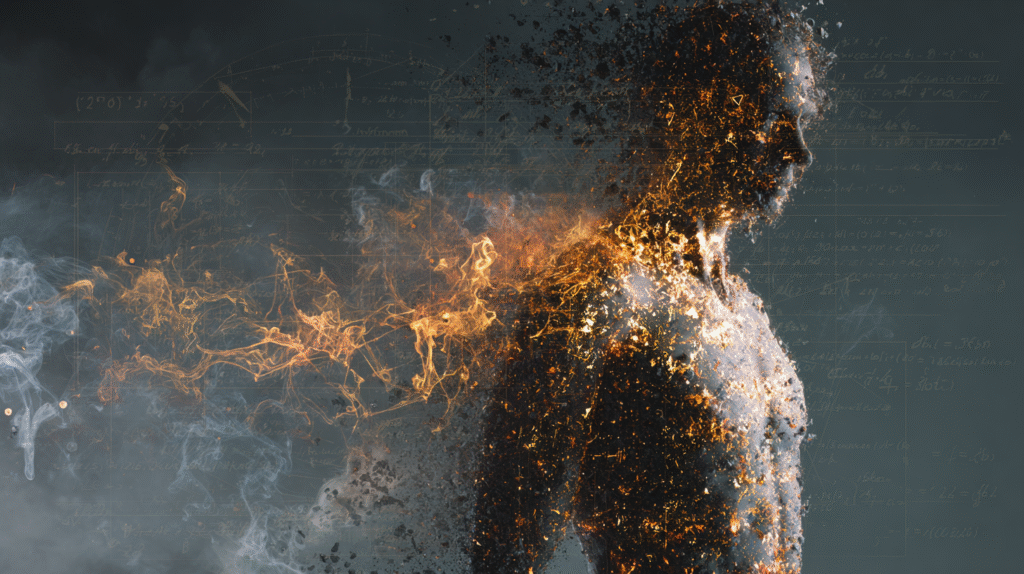
Every living system is, at its core, an improbable arrangement. The human body is not a static thing but a precarious suspension between order and collapse, an island of organization in a universe that drifts inevitably toward disorder. Physicists call this entropy. Physicians confront it daily. Yet in medicine we often speak of “cures,” as though disease were a foe to be defeated outright. In truth, medicine is not a conquest of entropy but its continual negotiation.
Medicine as Time’s Engineer
Consider a cell, humming with activity, powered by gradients and feedback loops. Each molecule strives to hold its place against the drift toward randomness. Aging, injury, and disease are not aberrations but natural accelerations of entropy’s hand. When a drug lowers blood pressure, when an antibiotic suppresses infection, what it truly does is delay disarray — it buys time for the organism to maintain improbable order a little longer.
This reframing is not just poetic. It changes how we think about intervention. Rather than asking, “Does this cure?” we might ask, “How long does this restore coherence? How far does it extend the system’s improbable balance?” In this sense, pharmaceuticals are temporal agents: they grant extensions of ordered life in a world that constantly unravels.
Pharmacology as Entropy Management
Every pill can be seen as a wager against disorder. Statins, for instance, are not eternal shields; they slow the thermodynamic drift that manifests as vascular chaos. Painkillers do not eliminate suffering’s root but suppress the neural storm, reintroducing temporary equilibrium. Even vaccines are entropy’s adversaries, not by erasing viral possibility, but by teaching the immune system to reorganize itself faster than chaos arrives.
This model resists the triumphalist language of eradication. No medicine escapes the second law of thermodynamics; no therapy grants permanence. But their power lies precisely in this temporal humility. They stretch the arc of coherence, allowing a human life to persist as an ordered pattern of thought, breath, and relation, longer than it otherwise might.
Disorder as the Universal Patient
When viewed through entropy, all patients are variations on a single theme: disorder arriving too fast, in too concentrated a form. Cancer is the runaway multiplication of cellular noise. Neurodegeneration is information loss within neural circuits. Sepsis is systemic collapse under microbial entropy. Medicine, therefore, is not a set of isolated battles but a single project: slowing the rate of disintegration.
This vision unifies pharmacology with the physics of time. It makes sense of why chronic illness dominates modern life: not because medicine has failed, but because it succeeds at stalling acute collapses long enough for slower forms of entropy to emerge. Each new therapy extends the game against disorder, yet the board is infinite.
Rethinking What It Means to Heal
If medicine is entropy management, “healing” cannot mean perfection or final victory. It must mean temporal reprieve — the creation of intervals where order reasserts itself, where the patient regains form and function amidst decay. To recognize this is not to diminish medicine’s value but to place it within the deepest laws of nature.
The entropic patient is not tragic but universal. To live is to organize improbably; to seek health is to preserve that organization as long as time allows. Physicians, pharmacists, and patients are all engaged in the same endeavor: the art of resisting collapse, of maintaining islands of order in an ocean of disorder.