By Dr. Liora Watterson
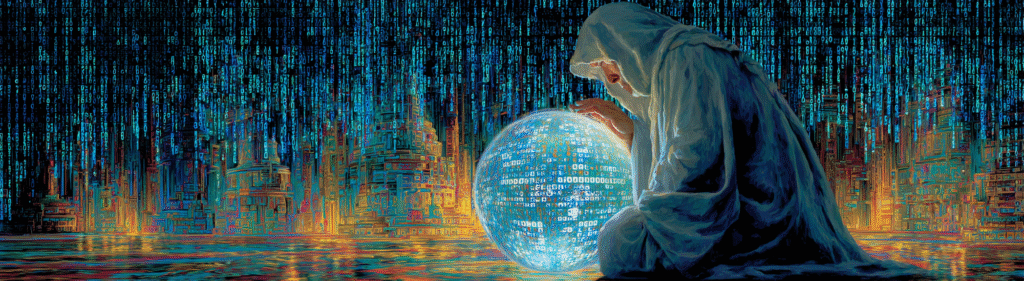
In the ancient world, kings consulted oracles before battle. Priests read entrails, astrologers charted the heavens, and prophets cast visions of futures to come. Today, executives and policymakers consult a different kind of oracle: predictive analytics. The data may come from credit histories, hospital records, or satellite feeds, but the promise is the same — foresight. In a world desperate for certainty, algorithms have become the new diviners, blurring the line between prophecy and probability.
The Ritual of Numbers
Like ancient rituals, predictive models require offerings — not incense or animal sacrifice, but data. Each click, purchase, and movement feeds the algorithm’s appetite. The outputs, wrapped in the authority of mathematics, are then interpreted by analysts much as augurs once interpreted bird flights. Few understand the hidden processes; fewer still question the legitimacy of the results.
Yet just as the oracle at Delphi spoke in riddles, algorithms too produce ambiguity. A credit score predicts risk but cannot explain destiny. A predictive-policing map points to danger but cannot tell whether crime will actually occur. Interpretation remains a human act, even when draped in the language of machines.
When Foresight Becomes Fate
The ethical tension lies in how these predictions are used. Ancient prophecies often shaped events simply by being believed — a king who feared his foretold downfall might act rashly, fulfilling the very vision he sought to escape. So too with algorithms: if an insurer predicts higher health costs for a community, premiums rise, access shrinks, and outcomes worsen. Prediction becomes self-fulfilling, an iron loop mistaken for inevitability.
When probability is treated as prophecy, freedom narrows. Human lives risk being governed by what is likely rather than what is possible.
The Question of Authority
Prophets once derived legitimacy from divine sanction; algorithms claim it from statistical accuracy. But authority is never neutral. Who designs the model? Which variables are weighted? Which outcomes are considered worthy of prediction? These choices embed power into the very structure of foresight. To defer uncritically to algorithms is to anoint their creators as modern priesthoods of probability.
The danger is not only that predictions may be wrong, but that societies may forget to question them — mistaking probabilistic foresight for moral truth.
Toward a Humble Prognosis
Perhaps what is needed is not to abandon prediction but to reframe it with humility. Ancient cultures treated oracles with awe but also with skepticism; prophecy was consulted, debated, and placed within a broader moral frame. Algorithms, too, should be subject to scrutiny, transparency, and ethical counterbalance.
We cannot return to the age of temples and auguries, but we can recognize that prediction, whether mystical or mathematical, always carries power. The question is not whether algorithms resemble prophecy, but whether we will remember to treat them as fallible — tools for choice, not chains of fate.