By Ronan Pierce
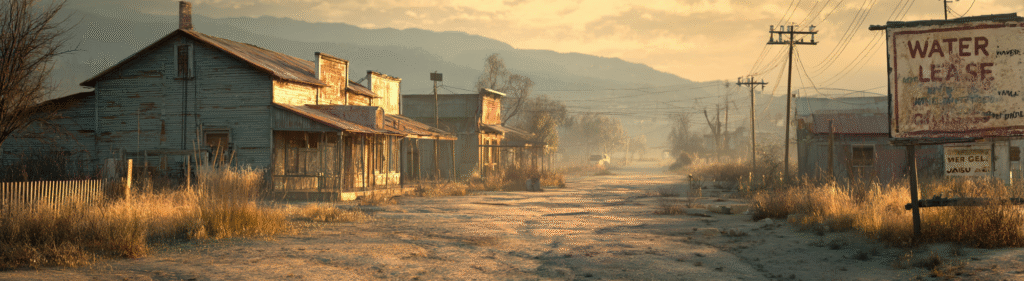
On the outskirts of a parched town in western Kansas, a hand-painted sign reads: “Water for Lease — Call Jim.” It hangs beside a field where wheat once grew, now cracked into a jigsaw of dust. Here, water is no longer just a necessity; it is a commodity, traded, hoarded, and leased like land. As drought deepens across America’s heartland, rural communities are discovering what it means when water becomes currency — and the bargain is rarely fair.
Wells Running Dry
Farmers speak of aquifers as if they were family members — vital, fragile, slowly dying. The Ogallala, once vast enough to irrigate generations, is shrinking fast. Wells that supported cornfields for decades now sputter out. Those with deeper pumps can keep drawing; those without face foreclosure. In this new economy of scarcity, survival depends less on skill than on access.
Rural towns are watching their lifeblood siphoned away. A café owner in Nebraska told me business used to depend on rainfall. Now it depends on whether her neighbors can afford water rights. “When the pumps go quiet,” she said, “so does Main Street.”
Markets in Thirst
Water trading has emerged as both lifeline and curse. Leasing water rights can keep small farmers afloat for a season, but it also accelerates consolidation. Wealthier landowners — often absentee investors — buy up rights and lease them back at steep prices. Some towns are caught in a loop where local water literally flows away, diverted to distant urban centers, leaving behind dry taps and empty schools.
Economists argue markets improve efficiency, directing water where it is most valued. But efficiency measured in dollars rarely aligns with community survival. For families who have farmed the same soil for generations, the value of water cannot be priced in cubic meters.
Human Costs of Scarcity
The shift from shared resource to private asset is tearing at the fabric of rural life. Neighbors who once swapped equipment now haggle over water leases. Churches pray not just for rain but for fairness. In one Colorado town, children ride buses past boarded-up farms on their way to schools slated for closure. As one teacher put it: “We’re teaching kids resilience while the ground under them disappears.”
The social toll mirrors the ecological one. A culture rooted in abundance — plant in spring, harvest in fall — is being remade around scarcity, uncertainty, and migration. Some families leave, chasing jobs where water still flows; others stay, gambling on the next wet year.
What Survival Requires
Policy can blunt the harshest edges. Programs that compensate farmers for conserving groundwater, investments in drought-resistant crops, and frameworks for cooperative water sharing all hold promise. But these require political will and community trust — both eroded when water itself is treated as just another tradable asset.
The drought economy is not abstract. It is written in abandoned barns, in auctioned-off pumps, in the taste of dust at the end of a long day. Whether small towns can endure will depend not only on rainfall but on whether society chooses to treat water as a common inheritance or as the last resource left to sell.