By Dr. Celeste Rahman
Climate change often feels like a story told at the planetary scale: degrees of global warming, sea levels rising worldwide, models projecting to the year 2100. But for a city planner deciding whether to expand storm drains or plant more trees, those planetary averages are too blunt an instrument. What they need is not a forecast for the Earth, but a forecast for their neighborhood.
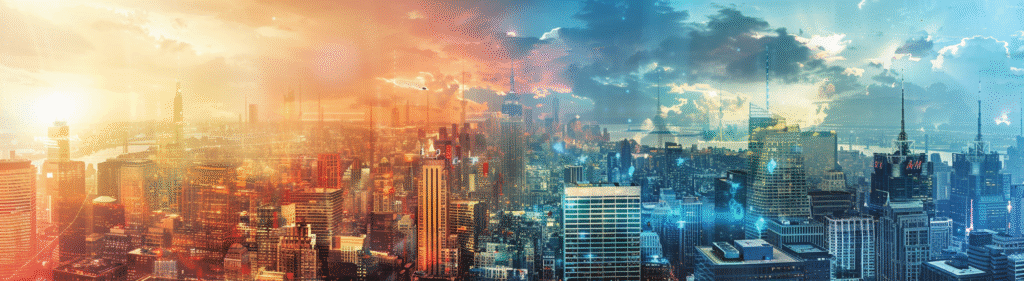
That’s where “downscaling” comes in. It’s the scientific process of taking coarse global climate models—think of them as the blurry outlines of a weather map—and sharpening them to the resolution of a city block. Instead of predicting rainfall shifts across an entire continent, downscaled models can estimate how a thunderstorm might behave in a single metropolitan basin.
The Science of Sharpening
Global climate models (GCMs) divide the planet into a grid, with each square often spanning hundreds of kilometers. This is like looking at the world through a pixelated photograph: broad patterns are visible, but fine details are lost. Downscaling uses statistical methods and regional simulations to add resolution—turning those large squares into finer pixels.
For policymakers, this detail matters enormously. A city like Miami doesn’t just need to know that “precipitation will increase in the Southeast.” It needs to know whether a particular flood-prone district can expect 20 percent more downpours, or whether intense rainfall events might double in frequency.
From Lab to Legislation
Cities across the globe are already using these sharper forecasts to shape policy. In Rotterdam, downscaled climate projections have informed a new generation of “water plazas”—public squares that double as reservoirs during heavy rains. In Los Angeles, hyperlocal heat maps are guiding tree-planting in neighborhoods where asphalt radiates like an oven. And in Dhaka, planners are combining downscaled flood projections with local knowledge of informal housing patterns to design more resilient drainage systems.
But here lies the tightrope: downscaling sharpens probabilities, not certainties. Think of it as adjusting the focus on a camera lens. The picture becomes clearer, but it is still an image of the future, not a photograph of the present. Policy built on these forecasts must balance urgency with humility, recognizing that every model carries assumptions and blind spots.
The Risk of Overconfidence
There is a danger in treating downscaled models as prophecy. Local officials, under pressure to act, may be tempted to take the most dramatic forecast and legislate as though it is inevitable. Overbuilt infrastructure can be as costly as underbuilt defenses, especially for cities already stretched thin.
Risk communication, therefore, becomes as important as the science itself. Citizens and leaders alike must understand that these models are tools for decision-making, not crystal balls. The art is in layering projections with community knowledge, historical records, and adaptive planning that can pivot as new data arrives.
A New Language of Preparedness
Downscaling does more than add detail—it reframes climate change from a distant, abstract threat into a local, lived reality. It translates “global warming” into “floodwater at the corner of 3rd and Main.” For city councils and mayors, that is the difference between paralysis and action.
In the end, the story of downscaling is not about perfect foresight. It is about giving communities sharper tools to shape their own resilience, even when the future remains, inevitably, a little blurry.