By Elias Watanabe
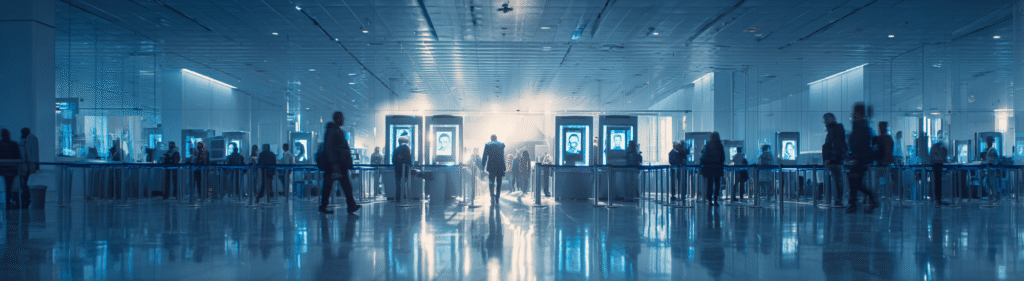
At a growing number of airports, your face is now your boarding pass. A quick scan, a green light, and you’re waved through—no fumbling for IDs, no manual checks. To the weary traveler, it feels like a glimpse of the future: seamless, frictionless, efficient.
But this future carries a shadow. As biometric border systems spread—using fingerprints, iris scans, and facial recognition to verify identity—the convenience they promise comes with a question few passengers stop to ask: What happens to all that data, and who controls it?
The Speed Argument
Governments and airlines pitch biometrics as a win-win. Shorter queues mean happier travelers. Automated identity checks free human officers to focus on higher-risk cases. And in an era of rising passenger volumes, automation is almost irresistible.
Pilot programs have shown dramatic results: boarding a full transatlantic flight in under 20 minutes, processing hundreds of arrivals without a single manual passport check. The case for speed is easy to make.
The harder case is for safety—not just from terrorists or smugglers, but from the erosion of rights.
Data That Doesn’t Expire
A credit card number can be changed. A password can be reset. But a face, a fingerprint, an iris—these are permanent. Once compromised, there is no “reissuing” them.
Biometric databases are now prime targets for cyberattacks. In 2019, a breach of a U.S. Customs and Border Protection subcontractor exposed facial images and license plate data. In 2021, India’s Aadhaar system—one of the world’s largest biometric repositories—suffered multiple leaks affecting millions. These aren’t just privacy failures; they are national security failures.
Even without a breach, the data itself is tempting to repurpose. Systems built for border control can be adapted for domestic surveillance. Today’s airport scan could be tomorrow’s public protest attendance record.
The “Consent” Problem
Supporters of biometric borders stress that participation is often voluntary. But anyone who has stood in a serpentine immigration line watching others breeze through the fast lane knows that “voluntary” is a slippery word. The pressure to opt in is structural, not explicit.
Worse, once a biometric identity is created in one jurisdiction, it can be shared with others—sometimes with minimal oversight. Information collected for one purpose may travel farther, and be used for more, than the traveler ever imagined.
Possible Futures
Biometric borders aren’t inherently dystopian. There are safeguards that can preserve both efficiency and freedom:
Strict data minimization—storing only what’s needed, and only for as long as necessary.
Independent oversight—ensuring that usage aligns with clearly defined, democratically approved purposes.
Transparent redress mechanisms—so travelers can challenge errors or misuse.
But these safeguards rarely appear by default. They are the product of negotiation, public scrutiny, and sometimes legal challenge.
The Real Border
The most important border may not be the one between nations, but the one between convenience and control. Cross it without care, and you may find that the line is easier to erase than to redraw.
The question for travelers—and the societies they inhabit—is not whether biometric borders are coming. They are. The question is whether, when we cross them, we still recognize ourselves on the other side.